Wednesday, July 17, 2013

Macheesmo...

Macheesmo is a phrase that Nick (the site owner) "came up with that simply means having confidence in the kitchen". I think it is so funny as "machismo" in Portuguese means "men being superior to women", but I am sure he didn´t mean that. Anyway, I follow some of his recipes and have great success with semolina bread and English muffins, the pictures can tell everything.
The semolina bread recipe I just doubled, but everything else I followed as directed. It turned out fabulous, slightly dense in the middle, not so crunchy shell - the taste and texture were superior to any other home-baked bread I´ve done so far. The semolina flour really makes a difference. Note: semolina flour in Brazil resembles that of regular flour, but not so fine, with white opaque color, much drier. My next adventure will be semolina pasta. Has Nick any recipe?
The English muffin recipe I did not let it rise a second time as I also watched the Culinary Institute of America video. But what I thought to be wise is to stick the muffins into the oven to finish up cooking. I have had many underbaked goods in the past, and that is an experience I don´t want to repeat. So the tip was very good. I actually opened one of them without baking, and indeed, it was slightly raw.
While the English muffins were in the oven, I fixed the Hollandaise sauce and boiled fresh eggs I got that morning directly from under the chickens. It was the first time I used a splash of white vinegar to boil eggs and the whites didn´t spread in the pan. Another success! I am so glad. Happier yet when I dug my fork into the Eggs Benedict. I was able to replicate the ones I used to eat at Royal Cafe, in Albany, California.

Tuesday, July 16, 2013

Full Steam

Full steam, or should I say "full smoke"? I am back baking full power. Not always in my wood-fired oven, sometimes due to time crunch or because sometimes I need a more reliable oven. To tell you the truth, I have not mastered the wood firing system and I can´t trust myself the oven is going to be ready by the time the dough is. That´s why making pizza is so easy - you can keep feeding the fire until the pie is ready to go.
This time I played with new recipes such as sweet potato bun, pesto potato bread, semolina bread, hamburger bun, and the two great findings: focaccia made from overnight poolish (www.breadcetera.com) and English muffin, which it is not strictly baking, but it is bread. The recipe from www.macheesmo.com directed to stick the fried muffin into the oven so to finish cooking. Great tip! It made superb Eggs Benedict. Semolina bread was also from the same guy. I had never been able to make such a nicely dense bread in texture, yet light in taste. This was good with mortadella (better kind of bologna).
Sweet Potato Buns from http://blogmaetocomfome.blogspot.com.br/2013/05/pao-de-batata-doce.html (In Portuguese)
Pesto Potato Bread from don´t know where recipe...
40-Minute Hamburger Buns from http://www.tasteofhome.com/recipes/40-minute-hamburger-buns
Focaccia from http://www.breadcetera.com/?tag=focaccia

Saturday, April 20, 2013

We Go (coco)Nuts!


What if you have more coconuts than you can drink their water?


Yes! We primarily plant coconuts for the water it stores in young green fruit.
And...what if the coconuts are becoming riper and the water inside is drying out, while its pulp is getting thicker?


The only solution is to use the ripe pulp to make sweets and baked goods.

This one is called "queijadinha" - cheesecake, but it is actually made with grated coconut and just a little bit of cheese.


RECIPE:

4 eggs
1 cup sugar or sweetened condensed milk
2 TBSP butter
4 TBSP grated cheese (we use "meia cura", mild parmesan-like cheese)
200 grams fresh grated coconut (or hydrated dry coconut flakes)
1 cup coconut milk (or milk)
3 TBSP white flour
1 tsp baking powder

Beat the above ingredients item by item, until all incorporated. Bake at 375 F.
Now, the country cooking will throw all ingredients, and perhaps omitting the liquid, and leaving out flour and baking powder, for they prime the real taste of coconut.

Green Papaya Compote


What should we do when we have soo many green papayas on the tree?


Green Papaya Compote, of course!


We don´t have real winters in most of Brazil, so no need to preserve seasonal fruits or vegetables - we have them all year round. When we do, it is because we want to eat it for our afternoon snack (we call it "afternoon coffee" - cafĂ© da tarde). Green papaya compote is one of the most popular, as papaya trees can grow anywhere taking up little space.

RECIPE: get a fully grown green papaya (not baby one, but before it starts to ripen) from the tree. Let it stand one night to draw out milky sap. The next day, peel it, cut it into pieces. Thicker pieces make creamier ones. Let the pieces soak overnight in water with one teaspoon of baking soda (for a crispy outside and creamy inside). Add sugar (less than a kilo of sugar for a kilo of green papaya) and about 2 cups of water to make syrup. Cook all the ingredients together with cinnamon sticks and cloves. Optional: add 2 fig leaves for aroma. This is a homemade recipe. You can have syrup in various degrees of thickness, color, or sweetness.

Green Fig Compote

I have a young purple fig tree with lots of green fruits...


So I had a good idea!


Made into green fig compote and served with Gorgonzola cheese...


Today I sliced the figs, placed over crackers, and sprinkled with Gorgonzola cheese for our afternoon tea at the church. It was rather an exotic plate for the type of cheese. Brazilians usually like to combine homemade preserves with fresh farmer´s cheese.

RECIPE: A bit laborious but well worth it. Pick green figs with gloves (or the milky sap may cause allergy), wash them, and put into boiling water for 10 minutes. Put them into the freezer until rock hard. Under the running water, peel each fruit (unless you don´t mind the skin). Drop peeled figs, some whole, some cut into half (your choice), cover with water, and add coarse sugar (granulated sugar is fine) to your taste. Usually, 1 kilo of fruit calls for 500 grams to 1 kilo of sugar. I used something in between. I allowed the fruits to cook and added a little more water to keep the syrup level at fruit level (that is, plenty of syrup). To make the compote taste and smell like figs, I added 3 leaves while cooking. Very often, we make green papaya compote (same process) but add fig leaves for the aroma. We like to add cinnamon sticks and cloves.

Turmeric Time


That´s how most of us know store bought turmeric - as a yellow powder


But it actually comes from a gingerlike root - Curcuma Longa


It starts from a plant like these - the leaves should be dry (mine are not quite yet)


Dig the small roots out to your joy!


Such a delight to see these wonderful "gold from the earth" - as it is known in certain parts of Brazil - sunbathing


For culinary use, I can just smash it, cut it, or grate it into the cooking rice or stews. But if I want to store it in a powder form, I heard, I need to boil, dry, and grate. Some people just sun dry it before grating. In either case, you will be rewarded with bright yellow tainted palms just like Moroccan women.


Monday, April 15, 2013

Morning Run

I can´t believe I have been running 3 miles most mornings for months now. I just haven´t had time to post it here - of course, too busy running. Well, it actually takes only 40 minutes every morning. I started slowly walking at a city park until I lost some weight (diet oriented by a dietician - two spoons of rice, palm-size piece of meat, and lots of salad, and things like that. No sugar or fatty meat for 6 weeks. It worked. I shed 10 pounds and even though I went back eating like a plowman, I am still able to keep my optimal weight. Sometimes I think that I could curb more of my appetite for novelty foods and lead a zen-like lifestyle. My pursue of simplicity hasn´t gotten to my stomach yet.
I started on this road in November - Summer in the South Hemisphere. Gentle rolling hills, no many cars, but lots of dogs (four checkpoints done by mutts), including mine that insist on following me. One of these days, one of them got killed by a car. All I said to the driver was "please, haul it from here". I used to run on a dirt road, but my dogs used to harass passersby, especially dangerous for motorcycles or bicycles. I was so distraught that I gave up the whole activity for months until I found the city park, and later, the paved country road near my farm. So I leave the farm by car and park by the road. But my dogs are smart. They discovered my little secret and sometimes they get to the starting point even before me.
My region doesn´t have much natural beauty. But I really enjoy my morning run. I can see (besides the dogs) birds (toucans too), a reservoir, some trees, and at the end of the paved road, a small Catholic church, a bar, and three houses (five people live here). On the back of the church has the most magnificent building of all: four giant wood-fired ovens! All roasted chicken, lamb, and pork are done in this facility for many church annual fairs.


Okra

Okra plant. Pods clinging too long...they may get woody. Not all Brazilians like okra - slime is to blame - nonetheless, the rest of us is absolutely crazy about it. To avoid getting it slimy, I heard you can add vinegar or lemon while cooking or washing, I am not sure. I do none of them. My strategy is to fry in hot oil, without stirring too much. Cutting into bigger pieces and patting washed okra dry also helps. Okra goes well in tempura, deep-fried coated with cornmeal, fried like potato chips, smothered with tomatoes, and combined with shrimp or chicken. We, country people, hundreds of miles away from the beach, eat smothered chicken with okra which is previously fried and added at the end (to avoid slime). Yeah, we can pickle okra too. I also eat it raw, sliced in diagonal, with soy sauce and drops of lemon. It can´t get any simpler.

Smothered Chicken in Fresh Turmeric, Mustard Leaves and Okra

My neighbor Rosa gave me a freshly butchered chicken that minutes before was freely running around her house. It was a payback for something that I don´t remember what. We trade goodies so often that it became part of our routine.
The free-roaming chicken was never part of my diet growing up. The first time that I saw it on a pot, I thought it was strange: skinny long legs, speckled yellow skin, though, and very little meat to eat. I have noticed lately that farm-raised chicken has been smelling strong, with soft slimy flesh, with fat marbling the breast fillet. So when my neighbor told me she would give me one from her stock, I watched as many videos possible on how best to cook it. While I used a crockpot to make the stock, I marinated the rest of the meat in garlic, onions, salt, and pepper overnight. (Brazilian cuisine is not much more than garlic-onion based seasoning.) In a large casserole, I fried the pieces until golden brown. I stepped out of the kitchen and plucked the roots of turmeric. I had never gotten turmeric roots before, so I was not sure I would find any. What a nice surprise to collect small, yet dark yellow roots that smelled earthy. I added small amounts of hot stock and ran again to my veggie garden to pick up some mustard leaves, cilantro, parsley, and green onions. Some more hot stock to pick up fresh corn, which was badly attacked by a bird from the parrot family. In the small patch of okra bushes, I have more pods than I can pick or eat. In an hour, lunch was late but ready. Such a delicious, substantial meal that I need a nap now.

Friday, February 8, 2013

Coffee Roasting Steps

This is a 2 - 3 year old coffee tree. Almost all coffee farmers harvest their coffee cherries by hand. It needs to be done in a fairly short period of time, as they may dry out in the tree or fall on the ground, yielding inferior quality. In most of Brazil, ripe cherries are first dried in the sun. This process produces coffees with less acidity and more body compared to the wet process.
Processed coffee beans are the result of ripe coffee cherries which are harvested and processed to remove the skin, pulp, and parchment, but still not roasted.
I learned to heat up the roasting pot first and then to load it with half of its capacity so to speed up the first batch.
Then we turn, turn, and turn the round roasting pot from 20 to 45 minutes until it starts smoking. At this point, neighbors go crazy for the enveloping aroma of roasting coffee...
As soon as start smoking, there is a split second in which we need to take the pot out of the flame to spread the coffee beans over a large sieve. At this moment, the coffee beans should be covered with shiny oil, and then they are perfectly roasted. One needs to shuffle or fan the beans so as not to over roast with their own accumulated heat. To achieve perfection, I am learning to roast imperfectly batch after batch.
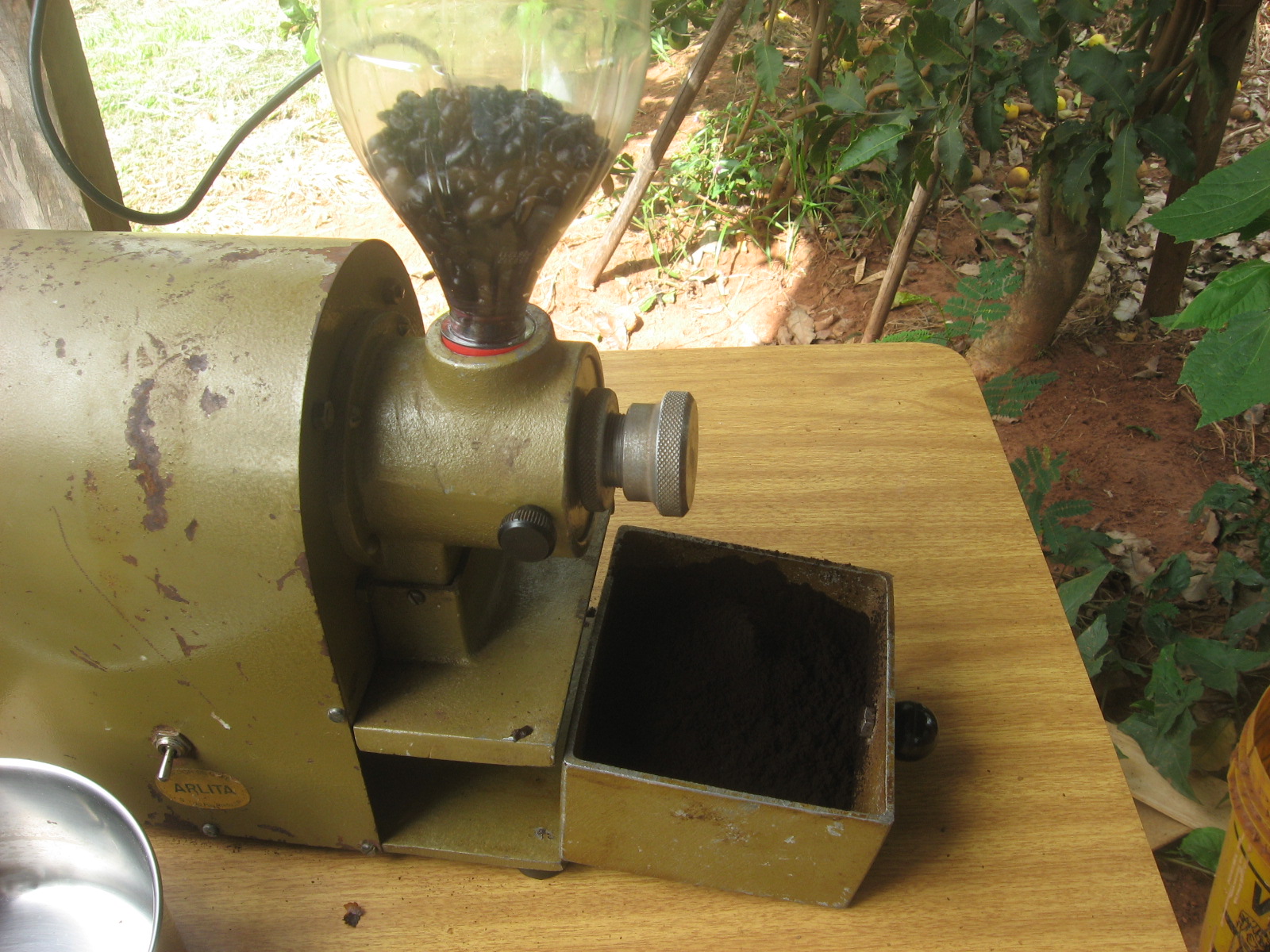
This is a modern version of a coffee grinding machine, an electric one. The older one is done by a hand-cranking device. We like our coffee finely ground, with medium acidity and a great body. We usually drink it strong and sweetened with cane sugar.
Home roasted coffee is done only in rural areas where a great amount of smoke can be produced. It is becoming rare as time passes. Giving home-roasted coffee is a good gift and such a great one that everyone wants some. Just like any other things made by farmers´hands.

Sunday, January 20, 2013

Bamboo Shoots

End of Spring in Brazil, the sun, the rain, the heat, the humidity bring new shoots of bamboo for our delight. It used to be my father´s job to harvest, to clean, to prepare, and even to cook the dish. I remember the last time he did it: he had kittens crawling on his shoulders as he worked. I tried to remember his steps, but failed on the important part, which was the preparation of the raw shoot into an edible one - to wash many times, boil with baking soda, to soak, and wash some more times. I rushed into cooking with basic Japanese seasoning, so have it all very bitter to the point of burning my tongue. I read that cianidric acid can make us sick, but even some boiling would remove most of the acid. So later, I boiled in clean water, turned off the heat, and added a little bit of baking soda. Immediately the water became dark browning yellow. I understood that it must the reaction between acid and alkaline. I changed the water a few more times, tried a piece and it tasted while slightly bitter, but it definitely had some sweetness to it. It is almost like artichoke. Actually, the bottom of the artichoke heart has the same texture as of bamboo shoot. The dish: I cut into thin strips the shoots, pork loin, ginger, green onions, and garlic. I stirred fry pork first with seasonings, removed it from the pan, and added a bit more peanut and sesame oil to fry the shoots. I seasoned them with a bit of sugar, soy sauce, and fish powder (Japanese seasoning). I returned the pork to the pan and let it combine for another minute. Voila. A quick Chinese dish eaten over rice. I will try some other recipes this week, as there are many shoots to be harvested and guests coming over to stay with us.

Thursday, January 10, 2013

Soapmaking on Thursday

It´s like Sunday. The sun and the rain gave us a little break, making our Thursday be quiet, hazy, quiet day. I actually started to make soap yesterday. I found a great recipe for household use, not totally from scratch, but it still feels like homemade. It takes 1 liter of liquid lye (lye solution at 50 Baume), 1 liter of coconut liquid soap, and 6 liters of reclaimed kitchen oil, properly filtered. I avoid using too smelly, dirty, stained, rancid, or watery used oil. The biggest thing about this recipe is that it doesn´t require stirring (!)no, no, no!!!! That is the best news after Kitchen Aid mixer. All I have to do is to transfer the mixture from one bucket to another, only until it turns opaque, creamy, and homogenous, with no trace of oil. The recipe recommended 4 times of transferring, with the risk of the mixture hardening in the bucket. But, it may be for the type of lye solution, or the oil, or the temperature, or the humidity, or else, it took me about 12 pourings before the final pouring in the plastic rectangular container I usually use for molding soaps. I cut the soap today, not totally hardened, but enough to slide a knife with care. I ran a test and it showed a great foamy soap. Let me wait until it is cured for a final review of the product. The second soap I made (today) was my regular tallow-reclaimed kitchen oil-alcool trio I have published as a slide show on the blog and also on youtube. The stirring took a bit longer, about 5 to 10 minutes, opposed to 2 minutes on other times. I can´t say it is for the different brands of lye, the ingredients temperature, or the weather. It is warm and humid. I think days like these are not good for making soaps. Sunny, lightly breezy, and dry days must be better. Especially because the soap doesn´t sweat by drawing air moisture. The third soap is a toilette one. I had babassu kernel oil leftover from a previous experiment, as well as pomace olive oil. Flaxseed edible oil, rather unedible for its bitter taste, went to the mix as well. In order to lower the percentage of babassu oil, I added soybean oil, so it won´t get too brittle or harsh on the skin. I used a lye calculator provided on the internet (www.brambleberry.com), which is very useful. I started stirring with a whisker but soon used a hand mixer. The saponification took place in less than 5 minutes, turning the mixture opaque, very creamy, and dense. It was almost difficult to pour properly into a cardboard shoebox. So I left the soaps resting, and let´s see tomorrow...

Friday, January 4, 2013

Christmas Bread Panetone

Another quiet Christmas on the farm with my daughter being away. But the days that preceded Christmas, I baked panettone, an Italian round tall bread filled with candied fruits and raisins or with chocolate chips. My first attempt was a disaster. I followed a recipe that required a long rise, two days of work, just to have all the top burned by tucking it into a too hot an oven. I used a wood-fired oven, and I still don´t know what´s the right temperature for each dish. The second panettone was filled with chocolate chip and topped with ganache. They turned out very velvety, moist, and delicious. This time I used a regular gas oven. The third recipe I chose to fill it with dulce de leche (some kind of hard caramel). I made a mistake with the amount of butter and again, it was a failure. The bread didn´t rise properly while baking. But I still could give to my neighbors. But I was decided to make one great panettone, so again, I was mixing the ingredients when my mother had a seizure so I had to put the dough into the fridge to run to the hospital. When I got back home at 1:30 a.m., I didn´t feel like cooking. So I proceeded the next day, turning out a good panettone. The panettones and the two loaves on the photo are from this batch. I gave it to my friends as Christmas gifts. I felt as I had done a great accomplishment. But I was still not happy with sweetbreads and wanted to bake one more panettone, a savory one, filled with some kind of beef jerky, properly de-salted, cooked, shredded, and cooked with onions. This time, it was a success. The recipe asked for dark beer, milk powder, and even kummel, which I didn´t find in the market. So it went without it. Again, I gave one to each of my three farmer friends. Panetone dough is different from all other bread I have made before, as the dough is quite sticky, with high hydration. It is thicker than cake mix and wetter than bread dough. It also takes a lot of butter and egg yolks, a typical holiday bread. Panetone with its orange-butter-vanilla aroma, fruits, chocolate, caramel, the rich dough is a feast in itself. It is a kind of bread we can´t go without. It is a symbol of Christmas which for me exhale beauty, abundance, generosity, and love.

Mochi Making

Mochi is a Japanese rice cake made of glutinous rice traditionally eaten on New Year´s Day. The mochi making process can be a ceremonial event or not. In my case, I made the way I thought it would work. I soaked the rice overnight, drained it the next day, and then ground it in an electric coffee grinder and put it to cook in a microwave oven with a little bit of water. After about 6 minutes of cooking, I pounded it with either a wooden spoon or with my new Kitchen Aid. After a few minutes, I shaped it into 2-inch rounds. The rice cake itself is very bland, and I love it for the texture. I can fry in a little oil, and then season with soy sauce and sugar or boil in a soy sauce seasoned broth. This time I wanted to make daifuku, which is mochi filled with sweetened azuki bean paste I made from scratch. Not hard at all. I just soaked the beans overnight, cooked it, drained it a bit, and cooked with sugar. As I stir with a wooden spoon, the beans break turning into a paste. Yummy! My interest in Japanese cooking became revived by watching animes, where the presentation of traditional food is quite common. Then, I search online for recipes and ideas. I have enjoyed on youtube "cooking with dog", "runnyrunny999", and "delicious nippon". I am still to make some dango, which ingredient I can´t find where I live, and I believe, some found in Brazil is imported. I may try to make the rice flour myself and make the dumplings later. Let´s see...

Saturday, September 29, 2012

Tofu Making Experience

I am still on eating little, so I have to make the most of what is on my dish. Unhappy with the sweetened store-bought soymilk, I started to make homemade soy milk and then, tofu. My main guide to tofu making is a book by William Shurtleff and Akiko Aoyagi, The Book of Tofu, while an inspiring book, I find it difficult to follow the recipes, with instructions to wash dishes while waiting for the milk to curdle (!). I have also surfed on the internet for recipes, but I couldn't find a forum to discuss the basics. After making a few times, and now following the instructions so closely, I finally found out that I didn't really need a recipe for soy milk or for tofu. The quality of the soybeans may determine the type of milk, and therefore, it is hard even to give out quantities in the recipe. So, my own recipe for soymilk and tofu are as follow: Soymilk: for 1 cup of dry soybeans, it yields for 1 liter or more, depending on how much water you want to add, or how rich milk you like. Soak beans overnight. Wash beans thoroughly the next day to eliminate impurities and some of the skin. Put 1 liter or more water to boil in a kettle. Puree beans with some hot water using a blender for 1 or 2 minutes. You can either dump puree into a pot and cook it or you can strain it first in a cotton sack and then cook the milk. In either case, you let it boil and then simmer for 10 minutes, stirring the whole time so as not to burn on the bottom. If you cook the puree, obviously, strain it later. Some recipes tell you to wash the okara (solids) with more water and press it firmly until the last drop. I find it difficult, so I skip this step. Tofu: In a 4-quart stockpot with almost 4-quart fresh soymilk just cooked, I stir a solution 2 teaspoons of magnesium sulfate (that's what I can find in my town)in a cup of water. The biggest secret is not to dump the whole solution at once, as I read somewhere that excess coagulant will make the tofu bitter. I do it in three steps. I pour some while swishing the hot milk (off the hot burner), and then put the top on. After a minute, I pour some more, if needed. I go pouring until the milk is all curdled. Attention: it curdles rapidly, but it is best to wait 2-6 minutes to allow the coagulant to work. I had times that I threw away the coagulant, some other times, I had to make some more. As soon as the milk is curdled, I take out most of the whey, so I can ladle the curds with minimum water possible into a forming container lined with cheesecloth. I wrap the cloth into the container, place some weight on top and wait about 5 to 10 minutes until most of the water had been drained. I quickly put the whole thing into a basin with cold water in an attempt to eliminate the taste of coagulant. If firm enough, I take the tofu out of the cheesecloth and deposit into another container with fresh water and place it in the refrigerator for later consumption. Of course, it can be eaten warm, but it is best cold, topped with green onions, grated ginger, and soy sauce. To your health! Obs: If you want soy milk ricotta, just add half of the coagulant at once to rich hot soymilk and let it sit uncovered for 20 minutes. It may turn out ricotta (make sure you drain it and wash it in freshwater) or just pudding. In this case, you have made silken tofu.

Friday, September 7, 2012

Frugal Living

Wednesday, 1:30 pm: I stopped by Dona Rosa’s fence and delivered pieces of Brazilian style fruitcake (made with prunes, raisins, guava paste, condensed milk, muscatel wine, ground almond ) and puba cake. The last one is made of mandioc roots left 7 days in water to be fermented, then ground, and dripped to dry. I was a little bit suspicious of the puba, as I don’t know I can trust home fermented food. If any weird bacteria gets in? The other package of the same goodies went to my other neighbor who was at home, snoozing. Even though I woke him up, he thanked me for the cake and for an hour conversation we had under a big flamboyant tree. Sunny, slightly windy, and dry day. I felt fortunate to cheer a friend who had his wife away taking care of her hospitalized sister. Only where time doesn’t cost much is that I can have the privilege of spending so much of it, in the middle of the day, in the middle of the week. Having times like these, disallow us to take vacations. Our holidays are ingrained in our day-to-day activities. Not that we don’t need rest – but we don’t have the need to go away, to take a trip, to see new places and new people. What we like are these old places with old friends. They are not old friends of mine, as I’ve met them not too long ago. However, for knowing each other’s struggles and victories that have the feeling of closeness. We all agree that the best thing in life is friendship. If our time doesn’t cost much, I can afford to spend more of it. We don’t think of the time in terms of investments and returns, but in letting, life goes by beside people that we love. The big secret of having a frugal living is not valuing life like a commodity, of wanting more out of it, to have the maximum profit. It’s the opposite. It is expecting nothing out of life, but to have it pass by. If I don’t feel I am entitled to possess things, to experience emotions, to collect memories; if I don’t feel I am entitled to have a life that is when we start getting a life. As part of my pursue of simple living, I also have chosen to eat less, but correctly. I was tired of feeling sick after gorging and gaining weight as a consequence. I am not overweight in any sense, but be a glutton seems immoral, in face of the world’s hunger. My biggest challenge is to cut down on my expenses on meat, trading for cheaper fruits and vegetables. That’s where frugal living comes in. As part of my plan to pay less and get the same, I attend to exercise classes for free done at community centers, five times a week. At 8:00 p.m. I turn off the TV, go to the bedroom for devotionals. I still do other things, such as writing, getting information on the internet, but I don’t surf, as I think it is a waste of time. I end up sleeping early and wake up before the sun. I love it: to beat the sun. My next project is to use less cleaning products, especially laundry soaps. I plan to use my homemade soap instead, and wash the clothes less often, as my habit is to do several loads a day. I keep my trips to the town to a minimum, so I can save not only on fuel but on any risk related to a car accident. Keeping risks to a bare minimum is a great way to save money. Frugal living also allows me to enjoy times of silence – for being alone is one of the greatest gifts we get – and it is still free.

Sunday, July 1, 2012

Nothing is All on Sundays

June is over. Many thoughts, no writings whatsoever. End of Fall, but thankfully we haven't had cold and dark days. It's been a year since my father passed away. Like the days that precede Easter, I can't express my feelings into words, remaining in a contemplation mode. Today is a beautiful Sunday. Perfect sunny day, the most pleasant temperature, no wind, no dust, no flies. And also silence on the farm. I had built a "nethouse" for my vegetable garden, but the veggies seem not wanting to grow. We had a long drought, a few days of very heavy rain, and no cooler days. The great advantage of placing a net all over is the absence of white butterflies and other flying critters. I was just not prepared for what came under the earth - ants. The hardest one to kill using natural methods. I remember the year I arrived at the farm how bountiful we had. Vegetation was lush, wild cucumbers and other goodies grew abundantly, trees were carried with juicy fruits, and best of all, I had a great vegetable garden cultivated with a minimum of knowledge. This year, the poncan orange tree shriveled, the lychee tree got some kind of new bacteria, no cashews, no mangoes, and almost no avocado. The new fruit trees that I planted yielded sour or tasteless oranges. Except for the lime tree, everything else seems to have gone wrong. Can you believe that my smooth skin chayotes grew some tough spikes? I only collect the young ones, as the older ones can really hurt. I watched a TV rural program this morning. It said that the swine raising is having many losses and some towns have gone to emergency state. It is really hard to bear with all the heartbreaking that farming brings. It doesn't depend solely on hard work, but on the weather, the international market, the world economy, and everything else. I still don't know what I should do in case my chicken coop tenant decides to leave, or if my mother's pension stops. I greatly depend on these two for a steady income and family survival. As I have told you before, my farm is almost all rented out, and I have kept a part of it for my orchard and garden. I don't even have animals such as pigs, cows, goats, sheep, or chickens. In truth, I can't have some of them because of my dogs, some other because of a lack of know-how, range-free chickens for the prohibition for having commercial egg farm on here. The only thing that I could have were pigs, but my daughter said that she loves spare ribs, bacon, sausage, loin so much that can't have them. So we continue having dogs only. The two cats that I had adopted got killed by our Border Collie mix. Sometimes I feel that I am not living a real farm life - of course not. I can't have the basic things such as farm animals. But I still love living on the farm. I wake up early and can breathe fresh air while sipping a cup of coffee, which was roasted and grounded by me. While the farm is not producing as much as I expected, the town is fun. On Sundays, there is a nice farmer's market on the main street, close to butcher shops, which we have many alongside with pharmacies. While the restaurants are poor in town, the butcher shops roast beef, pork, and chickens for our Sunday lunch. The cheapest and most popular item is the roasted chicken with potatoes. The meat falls apart, while the bones come out clean. Some chickens get seasoned mandioc flour or cornflour stuffing. That's a plus too. But to me, the real advantage of living on a farm has to do with Sundays which used to be very boring - the "nothing to do" day. Now I expect Sunday especially for being a "nothing to be done"day. I want all the silence it can offer. Like orthodox jews observe their Sabbath, I want my Sunday even motionless. No driving, no going out, no visitors, no phones, no decision to make. I just want to rest my head on a cushion and stare at nothing. Nothing is all on Sundays.

Friday, May 4, 2012

Life Never Left Us

I was going to write “life is slowly coming back to the farm”, but, in truth, life never left us. A series of new happenings made me aware that life continues on, in its eternal cycle. It rained after a long drought. The very hot days are over now. It´s the Fall season. I am planning to start a new vegetable garden, in a smaller scale, closer to my house, in its original place. The “professional” spot where we cultivated two years ago was yield to the cattle. I rented out the spot. I have called the carpenters to build a structure that will hold a net that blocks 30% of the sun. And hopefully, it will stop white butterflies from sitting on the leaves. It looks like a greenhouse, except that it is not temperature or rainproof. Vegetables don´t grow too well under the hot sun, and that´s why it´s mandatory to have all this netting. The old patch didn´t have it – I had great veggies, but, they were tougher than the ones that we find at the market. I am excited about this new project. More than having a passion for growing veggies, I love freshly picked leaves for salads and the freedom from visiting the farmers´market. A few days ago I was looking for watercress for a special dish (oxtail stew). No grocery stores would have it, so I needed to wait for the market´s day in order to prepare this food. Sometimes I want cilantro, and almost no one has it. Fresh basil? I think I am the only person who loves it. In less than a month, I should have arugula, which is one of my favorite leafy green. In four months, my garden will have all that I used to have before, and probably nobody else in town. Who can grow (or know) celery? Peas? Edible flowers? Just me who had the privilege of living in the San Francisco Bay Area.

Sunday, February 26, 2012

God´s Blessings in Our Lives Slideshow


You can also see at:
http://www.youtube.com/watch?v=qwHWQTJIaE0

So finally I got to take some pictures of my small town on a January Monday morning. The main avenue is usually very crowded with cars and pedestrians, specially on Saturdays were walking is a hassle, trying to swerve from slower people or even avoid bumping onto others that are standing up, chatting. Not very uncommon too is to find people that walk in groups, stopping all at once to see the shop windows. This particular morning was very calm, but even so, many people cross streets away from crosswalks. It is just part of their habits. I wanted to include scenes that I usually see - men drinking coffee in the morning while chatting to each other, retired men sitting on a park bench, dozens of bicycles speeding down the street, and other particularities that make this town alive. Nature pictures mostly taken on a farm, but some were taken elsewhere, but they all makes part of my life. For instance, I can't raise free range chickens as I lease our chicken coops for a large scale egg business. Foreign birds could bring diseases to thousand of chickens, reason why I gave away my tamed Guinea hens. The little chicks playing with the girls were also given away after a few days. The House - is freshly painted but no longer looks that tidy. Specially the farm kitchen where there is always something going on, such as sinkfull of dishes to be washed or a trail of flour all the way to the wood fired oven. The Food - I made them all - from scratch - except for the farmer's cheese that I buy from a neighbor. I got no cows. What really misses in pictures is the vibrant energy of all the processes. The bread was not made dark like that, but it started from addition of flour, water, yeast, salt, sugar. It had different body, texture, temperature - it was something else, to become what it did. This dynamic process where aroma and taste are released is a priviledge of those who can live near them. I often tell my daughter how lucky (or blessed) she is for having a mom who cooks, for living on a farm, for owning eight dogs, and for all we should be grateful.

Saturday, February 25, 2012

Baking Season


Two beautiful Fall days in the middle of Summer. Who can explain that? It’s darker in the morning around 7, but the evening is still long with daylight savings. The sun rays have the orange hue, different from Spring were the sparkling silver rays invade all rooms. The lack of natural beauty of our landscape on the farm makes me enjoy the sensation brought by other senses. I am lucky for that matter. I am not a visual person.
February is here. My 10-year-old daughter is back in school. I still have to drive her five days a week on a rather short drive (about 6 miles) on a flat and straight road, but dangerous due to drivers’ carelessness.
December and January were cooking, baking, eating months. Even though the doctor suspects I have gluten intolerance (no exams done), I baked several times a week using my newly assembled wood-fired oven. But the highlight was the church gathering day at my house. I tested several pizza dough recipes, watched the oven, learned to open the skin by hand until I found the best dough and the best way of serving piping hot pizza straight from the oven for several people. I didn’t know how many would come, so I planned for 30. I soon found out that I couldn’t open the skin and bake a raw crust to serve 30 hurried peopled at once. Too many issues involving the making of the perfect pizza, Neapolitan style. I had to compromise. I parbaked the crust a day before, topped 3 pizzas just 2 hours prior to serving, and hired a neighbor dona Rosa to take care of the baking. I took care of topping the pizza as the first ones got done. On my list, nine different combinations which included the all-American pepperoni or sausage, mushrooms, and bell peppers; also sliced smoked pork sausage with onions; ham, peas, onions, cooked eggs. All pizzas take tomato sauce (made with fresh and canned tomatoes) and mozzarella cheese. The event was a success, so much that I totally forgot to take a picture of the crowd around the pizza, all praising me with a full mouth, not knowing if they should speak or chew. I was as busy as a pizza maker on a ball day, topping on disk after the other. Later, I had to ask other people who ate what, who took the first piece, who had anchovy with olives. I sent home a few people with pizza for their family. “We had plenty. My husband ate, and even my mother-in-law” – someone told me.
I can't help myself but continue cooking, baking, soap making, and all. I also baked old fashioned English bread called scone to be dipped in lemon curd (it's a lemon season), Brazilian finger good called "empada" - little chicken pies, sweet rolls, broa (a country bread made in cooked corn and wheat flour, and later baked), Brazilian cheese bread, chocolate chip cookie, anise biscotti dipped in chocolate, whole wheat bread, and even "Artisan Bread in Five Minutes a Day" bread. And more pizzas, of course.
I can't post pictures of all my bakings, neither remember all that I cooked - there were so many goodies.