




 In Brazil, Summer break starts sometime in December and it usually goes until after the Carnival – a religious holiday that transformed into a big national event. Being so, I don’t go to town twice a day as I used to, but I still need to run my errands a few times a week. With extra time on my hands, I started to walk on a road I used to run, a little less, as my dogs bark at motorcycles and even to cows belonging to somebody else. To avoid any situation, I interrupt my walk. They are so many (6) that I won’t have enough time to strain all of them before I leave. One Sunday before Christmas another puppy joined our pack. It was said to be a Pinscher Border Collie mix. To me, it is another mutt.
Every morning and every afternoon, I sit on my veranda chair to relax. The cool fresh morning air, contrasting with hot bitter coffee, I sit there enjoying myself. The dogs come to greet me, the puppy wants extra attention, and I raise my legs to a leg rest and rest. In the evening, after the sun has set, I also sit there remembering how much my back porch has improved. It used to be the portrait of a decadence. My father’s lack of financial resources to give it a little lift. After his death, I sold many farm equipment, as I decided to lease out the land instead of working on it (I tell the reasons later). With the money dripping in, I started to fix up the house, and after three months, I have the whole house fixed up and re-painted. Some areas such as the kitchen got a total makeover. I had the tile floor and wall changed, bought new appliances, and above all, took all the old stuff out of the house. My mother and sister used to oil paint canvas. We had several of them stored for decades. I hang them up on walls, making the house looking cheery. The biggest effect of the fixed up was the impression that it is not a dying place anymore. Yes, it had a solution for something that I thought could never happen. Sadly, it took my father’s death to make his inheritance take value. I live now in a newer, clean house. I didn’t have to make any major purchase, except for the kitchen, but lots of little ones made a difference. For instance, the drawer chests had a piece of fabric replacing the original knob since my childhood. I spent a few reais to buy new knobs on the furniture to take on a new look. Besides new painting giving an impression of clean walls, which were not only dirty but crumbling, the tiles cracked or simply missing on several spots in the house, the removal of old curtain tracks (yes, it was not a modern rod) for newer rods and curtains.
I had two men coming to do the job. They are dona Rosa’s brothers. During sugar cane harvest, they have work, but between September to March, they go unemployed. Even though they are not professional carpenters, they bravely took the job. Of course, many things were far from perfect, but I enjoyed the company. My biggest concern was to have a stranger working inside the house while I was out, but it turned out that they didn’t touch anything that shouldn’t be. They must come back to fix up the fence around the house – strangely, the fence was my first concern, but became the last one on the list.
Inside and outside of the house finished, including the set up of my wood-fired oven coated with red mud and cow’s fresh manure, I am working on my new interest: flower garden! I have already spent some to buy two palm trees and other plants. My main interest lays in forming a tropical garden with heliconias, bromeliads, ixoras. The plants that survived my mother’s illness (she used to have a very diverse plant material all over the garden, including a collection of orchids) were a few. Indeed they were sturdy, surviving lack of water or fertilizers over ten years. I felt sorrowful in eliminating what was there to give place to a whole new garden. I couldn’t cut down all the hibiscus, gardenia, dracaenas, rhododendron, zedoary, grass, hydrangea, ixora, bougainvillea, pata-de-vaca - a Brazilian native beautiful tree with perfumed white flower -, and many more, including a native berry tree. How could I make a beautiful landscape preserving all of those? After some research, I decided not to eliminate them, but crowding the spot with more plants, especially tropical ones, without any rigidity of a French garden, but rather more organic and natural – letting nature do it.
Lastly, my next upcoming project is to revive my organic vegetable garden. The old spot is full of weeds, dry, and rock hard. But it was once a lush garden, so it can be it again. This time, though, I am going to build a shade, as the sun is the inclement most part of the year and no leafy greens can survive.
The deep sadness that I feel with the loss of my father brought up new hope for living on the farm that I had once given up upon.
In Brazil, Summer break starts sometime in December and it usually goes until after the Carnival – a religious holiday that transformed into a big national event. Being so, I don’t go to town twice a day as I used to, but I still need to run my errands a few times a week. With extra time on my hands, I started to walk on a road I used to run, a little less, as my dogs bark at motorcycles and even to cows belonging to somebody else. To avoid any situation, I interrupt my walk. They are so many (6) that I won’t have enough time to strain all of them before I leave. One Sunday before Christmas another puppy joined our pack. It was said to be a Pinscher Border Collie mix. To me, it is another mutt.
Every morning and every afternoon, I sit on my veranda chair to relax. The cool fresh morning air, contrasting with hot bitter coffee, I sit there enjoying myself. The dogs come to greet me, the puppy wants extra attention, and I raise my legs to a leg rest and rest. In the evening, after the sun has set, I also sit there remembering how much my back porch has improved. It used to be the portrait of a decadence. My father’s lack of financial resources to give it a little lift. After his death, I sold many farm equipment, as I decided to lease out the land instead of working on it (I tell the reasons later). With the money dripping in, I started to fix up the house, and after three months, I have the whole house fixed up and re-painted. Some areas such as the kitchen got a total makeover. I had the tile floor and wall changed, bought new appliances, and above all, took all the old stuff out of the house. My mother and sister used to oil paint canvas. We had several of them stored for decades. I hang them up on walls, making the house looking cheery. The biggest effect of the fixed up was the impression that it is not a dying place anymore. Yes, it had a solution for something that I thought could never happen. Sadly, it took my father’s death to make his inheritance take value. I live now in a newer, clean house. I didn’t have to make any major purchase, except for the kitchen, but lots of little ones made a difference. For instance, the drawer chests had a piece of fabric replacing the original knob since my childhood. I spent a few reais to buy new knobs on the furniture to take on a new look. Besides new painting giving an impression of clean walls, which were not only dirty but crumbling, the tiles cracked or simply missing on several spots in the house, the removal of old curtain tracks (yes, it was not a modern rod) for newer rods and curtains.
I had two men coming to do the job. They are dona Rosa’s brothers. During sugar cane harvest, they have work, but between September to March, they go unemployed. Even though they are not professional carpenters, they bravely took the job. Of course, many things were far from perfect, but I enjoyed the company. My biggest concern was to have a stranger working inside the house while I was out, but it turned out that they didn’t touch anything that shouldn’t be. They must come back to fix up the fence around the house – strangely, the fence was my first concern, but became the last one on the list.
Inside and outside of the house finished, including the set up of my wood-fired oven coated with red mud and cow’s fresh manure, I am working on my new interest: flower garden! I have already spent some to buy two palm trees and other plants. My main interest lays in forming a tropical garden with heliconias, bromeliads, ixoras. The plants that survived my mother’s illness (she used to have a very diverse plant material all over the garden, including a collection of orchids) were a few. Indeed they were sturdy, surviving lack of water or fertilizers over ten years. I felt sorrowful in eliminating what was there to give place to a whole new garden. I couldn’t cut down all the hibiscus, gardenia, dracaenas, rhododendron, zedoary, grass, hydrangea, ixora, bougainvillea, pata-de-vaca - a Brazilian native beautiful tree with perfumed white flower -, and many more, including a native berry tree. How could I make a beautiful landscape preserving all of those? After some research, I decided not to eliminate them, but crowding the spot with more plants, especially tropical ones, without any rigidity of a French garden, but rather more organic and natural – letting nature do it.
Lastly, my next upcoming project is to revive my organic vegetable garden. The old spot is full of weeds, dry, and rock hard. But it was once a lush garden, so it can be it again. This time, though, I am going to build a shade, as the sun is the inclement most part of the year and no leafy greens can survive.
The deep sadness that I feel with the loss of my father brought up new hope for living on the farm that I had once given up upon.

 Folar is an Easter bread that can be sweet or savory, depending upon the region of Portugal. What is different about this recipe is the incredible amount of eggs in the dough. The best thing is that it turns out light, fluffy, yet full of flavor, with a delicate crust that melts in the mouth.
The first time I heard about folar was at a hair salon. The lady taught me how to make this bread, and also paella with rabbit meat. I never got to make the paella her way, but I sure made folar a few times.
Over twenty years had passed, and here am I again making folar on an improved recipe I found on the internet at www.gastronomias.com. For those ones who cannot read Portuguese, I shall translate it for you with my own personal twist (and experience). This is a great recipe.
1 kg all-purpose flour
12 eggs (yes, 12!) with shells warmed in warm water before breaking
250g melted butter
50g olive oil
30g compressed fresh yeast melted in ¼ cup warm water
Warm milk and salt
Smoked sausage sliced, salt pork or bacon cut into small cubes, ham, roasted chicken
In a large bowl, make a well in the center of the flour. Pour melted yeast and eggs, mixing in a circle, adding the flour little by little. Add butter and oil. If the dough is stiff, add a little bit of warm milk with salt to taste. It´s a soft dough, so you do more beating kind of movement than kneading until it forms a ball. Let it rise.
The recipe instructs to divide the dough into 3 and make layers (like lasagna) with meat. Let it rise again, and then, brush with egg wash, and bake in a hot oven for 45 minutes.
I have done it differently. I was so tired and sleepy that night that I stashed into the fridge until the next morning. I took it out of the fridge, kneaded a bit, and stretched with a hand roller. I cut the dough into 2, opened it like a pizza crust, and spread the meat over. I rolled it (like would sushi), tucked the sides underneath, and let it rise. Over two hours later, and with the dough risen greatly, I popped them in a hot oven for about 30 minutes. I lowed the temperature a bit, so as not to burn. They came out huge, light, fluffy, and tasty.
The next day I used the same recipe and process, but filled with provolone cheese and the other piece with green olives. I can’t say which one is the best.
Folar is an Easter bread that can be sweet or savory, depending upon the region of Portugal. What is different about this recipe is the incredible amount of eggs in the dough. The best thing is that it turns out light, fluffy, yet full of flavor, with a delicate crust that melts in the mouth.
The first time I heard about folar was at a hair salon. The lady taught me how to make this bread, and also paella with rabbit meat. I never got to make the paella her way, but I sure made folar a few times.
Over twenty years had passed, and here am I again making folar on an improved recipe I found on the internet at www.gastronomias.com. For those ones who cannot read Portuguese, I shall translate it for you with my own personal twist (and experience). This is a great recipe.
1 kg all-purpose flour
12 eggs (yes, 12!) with shells warmed in warm water before breaking
250g melted butter
50g olive oil
30g compressed fresh yeast melted in ¼ cup warm water
Warm milk and salt
Smoked sausage sliced, salt pork or bacon cut into small cubes, ham, roasted chicken
In a large bowl, make a well in the center of the flour. Pour melted yeast and eggs, mixing in a circle, adding the flour little by little. Add butter and oil. If the dough is stiff, add a little bit of warm milk with salt to taste. It´s a soft dough, so you do more beating kind of movement than kneading until it forms a ball. Let it rise.
The recipe instructs to divide the dough into 3 and make layers (like lasagna) with meat. Let it rise again, and then, brush with egg wash, and bake in a hot oven for 45 minutes.
I have done it differently. I was so tired and sleepy that night that I stashed into the fridge until the next morning. I took it out of the fridge, kneaded a bit, and stretched with a hand roller. I cut the dough into 2, opened it like a pizza crust, and spread the meat over. I rolled it (like would sushi), tucked the sides underneath, and let it rise. Over two hours later, and with the dough risen greatly, I popped them in a hot oven for about 30 minutes. I lowed the temperature a bit, so as not to burn. They came out huge, light, fluffy, and tasty.
The next day I used the same recipe and process, but filled with provolone cheese and the other piece with green olives. I can’t say which one is the best.
 When I first took an interest in country-style bread baked in a wood-fired oven, I asked my neighbor that I barely knew to teach me the secrets of the trade. I was after the type of bread stored in my childhood memories that tasted much different from the bread I eat today, even if baked in wood-fired ovens. Dona Rosa, then, told me that her sister who lives several miles away had “yeast in a bottle”.
A few days ago, I put in a bag a package of cookies, flour, and sugar (these were to be given as gifts), picked up Dona Rosa, and headed for her sister´s house. She lives in a very small rural community of dozen homes in a rather scenic route. I used to drive this road while taking “Pro-Milk”, a course to learn how to work with milking cows.
We were greeted by four women, an elderly lady, two middle-aged women, and a teenager. The older lady is Dona Rosa´s mother who is already a great-great-grandmother. Dona Rosa herself turned a great-grandmother at the age of 50. Anyway, we all seated on the sofa and they talked about people’s state of health. I tried to be interested but my mind wondered how soon I was going to see the starter. I noticed that the wood walls looked grungy, as my mom used to say the wood houses always look dirty and dark. Sometimes it holds a smell. At a certain point, the lady announced that she would make some coffee and disappeared into the kitchen. About thirty minutes later, she invited us to sit at the table.
She served us two plain deep-fried dough. Davina said that the first one was made of flour, water, and baking powder. The second one was made with a sourdough starter, “so I could see the difference”. Anything fried makes just flour and water taste delicious. Some were puffed up, but they had no filling.
Over an hour and still no signs of the starter. Only when everybody was finished, included some family members that joined us later that Davina took the prized starter from the fridge, kept in a 1-liter Coke plastic bottle. About one inch of flour on the bottom, and 500 ml of liquid. It was inert, no bubbles or foam. It looked flat and watery. She gave me the recipe to feed the starter: 9 tablespoons of flour, 3 tablespoons of sugar, and 1 teaspoon of salt. She omits the type of spoon, so on my first experience, I added too much salt.
The great day came; I treated my starter, took half for the bread, and kept half in the fridge. The bread recipe was 2 kg flour, 500 or 600 ml starter, less than a cup of oil, some water, sugar, and salt. The dough came out very stiff, but I didn’t know how it was supposed to be. So I added more starter and oil. I left the dough rest for the night, punched it down the next morning, stretched the dough with a hand roller, and free-formed them. Another few hours until they went to Dona Rosa’s wood-fired oven.
The bread smelled like sweet yeast (if this thing exists), it tasted slightly sour, but not quite like California sourdough bread. The density and the texture, besides the pale color of the crust, definitely I can tell that I have reproduced the bread of my childhood.
The bread became better with further bakings, and I have used the starter to make a deep-fried dough and also pizza crust. I thought to be a mix of tough and chewy crust, but the taste had character. Something to become addicted to. The next day, I heated over a dry pan and the crust became crunch and even more delicious.
I am still to try sourdough pancakes and guava paste filled fried dough.
Yeah, I dumped the two other starters I had made at home from scratch. They were too sour, almost offensive. To taste, the “yeast in a bottle” is sweet and mild. Interestingly, it rises better in a tall narrow container. When kept tightly closed in a bottle, at the opening, it may burst like champagne. How fun!
When I first took an interest in country-style bread baked in a wood-fired oven, I asked my neighbor that I barely knew to teach me the secrets of the trade. I was after the type of bread stored in my childhood memories that tasted much different from the bread I eat today, even if baked in wood-fired ovens. Dona Rosa, then, told me that her sister who lives several miles away had “yeast in a bottle”.
A few days ago, I put in a bag a package of cookies, flour, and sugar (these were to be given as gifts), picked up Dona Rosa, and headed for her sister´s house. She lives in a very small rural community of dozen homes in a rather scenic route. I used to drive this road while taking “Pro-Milk”, a course to learn how to work with milking cows.
We were greeted by four women, an elderly lady, two middle-aged women, and a teenager. The older lady is Dona Rosa´s mother who is already a great-great-grandmother. Dona Rosa herself turned a great-grandmother at the age of 50. Anyway, we all seated on the sofa and they talked about people’s state of health. I tried to be interested but my mind wondered how soon I was going to see the starter. I noticed that the wood walls looked grungy, as my mom used to say the wood houses always look dirty and dark. Sometimes it holds a smell. At a certain point, the lady announced that she would make some coffee and disappeared into the kitchen. About thirty minutes later, she invited us to sit at the table.
She served us two plain deep-fried dough. Davina said that the first one was made of flour, water, and baking powder. The second one was made with a sourdough starter, “so I could see the difference”. Anything fried makes just flour and water taste delicious. Some were puffed up, but they had no filling.
Over an hour and still no signs of the starter. Only when everybody was finished, included some family members that joined us later that Davina took the prized starter from the fridge, kept in a 1-liter Coke plastic bottle. About one inch of flour on the bottom, and 500 ml of liquid. It was inert, no bubbles or foam. It looked flat and watery. She gave me the recipe to feed the starter: 9 tablespoons of flour, 3 tablespoons of sugar, and 1 teaspoon of salt. She omits the type of spoon, so on my first experience, I added too much salt.
The great day came; I treated my starter, took half for the bread, and kept half in the fridge. The bread recipe was 2 kg flour, 500 or 600 ml starter, less than a cup of oil, some water, sugar, and salt. The dough came out very stiff, but I didn’t know how it was supposed to be. So I added more starter and oil. I left the dough rest for the night, punched it down the next morning, stretched the dough with a hand roller, and free-formed them. Another few hours until they went to Dona Rosa’s wood-fired oven.
The bread smelled like sweet yeast (if this thing exists), it tasted slightly sour, but not quite like California sourdough bread. The density and the texture, besides the pale color of the crust, definitely I can tell that I have reproduced the bread of my childhood.
The bread became better with further bakings, and I have used the starter to make a deep-fried dough and also pizza crust. I thought to be a mix of tough and chewy crust, but the taste had character. Something to become addicted to. The next day, I heated over a dry pan and the crust became crunch and even more delicious.
I am still to try sourdough pancakes and guava paste filled fried dough.
Yeah, I dumped the two other starters I had made at home from scratch. They were too sour, almost offensive. To taste, the “yeast in a bottle” is sweet and mild. Interestingly, it rises better in a tall narrow container. When kept tightly closed in a bottle, at the opening, it may burst like champagne. How fun!

 My Very First Sourdough Bread
I am diving deep into the rural culture of doing everything from scratch. After the experience of baking pizza in my new wood-fired oven, I took interest in the wild yeast fermentation process, the .sourdough starter.
Most of the time, my only door to the outside world is the internet. I researched all I could to learn the process. It is rather a very easy thing, just like soapmaking.
I began with two different recipes, one that I followed more closely, and the other one that I ended up doing my way – both turned out OK. In the first days, neither mixture would show anything except slight deterioration. The chef James Beard´s recipe called for flour, sugar, milk, water, and later on, a package of dry commercial yeast. As I had only instant dry yeast, I used compressed fresh yeast. The mixture never really bubbled, looking more like yogurt, even though it smelled like good beer. The other mixture I used just flour and water, and it looked flat, lifeless until I decided to feed more flour. Then, it started to foam. Unlike others I have seen on the internet that make large bubbles, even on the bottom of the container, mine was foamy only on top, but sticky all through.
After seven days or so, I prepared Beard´s recipe. For the bread dough itself, he calls for a package of active dry yeast, which I didn´t have (I found only the instant one or the compressed kind in the store), so I was forced to use the instant yeast, as the compressed had green mold on it. It took a rise, a punch down, another rise, and then to shape it into a roll. I think my problem started at this point, as the end result was a flat, dense, slightly raw tasting bread, which ended up tasting deliciously tangy, with a dry thick crust on top and smushy bottom. First, I left the dough rise too long for the type of yeast after I shaped it. The dough opened on the top, showing some bubbles. Then, it suffered from the low-temperature oven, which instead of baking in 30 minutes, took over an hour. I was so dismayed that I would have gone to town to buy a good stove just to bake my other bread tomorrow. But tomorrow is a holiday and all stores are closed.
Meanwhile, the other dough is still left to rise. I am soon going to punch down and mold it into a free form and tomorrow, to see how it tastes. I am most curious about this one as it doesn´t have any commercial yeast, and the dough rose wonderfully.
I am going to ask my neighbors to help me bake my bread in their wood-fired oven. Or I will lose my hard-worked dough. After all, for this one, it is going to be 10 days of watching, caring, kneading, and expecting.
My Very First Sourdough Bread
I am diving deep into the rural culture of doing everything from scratch. After the experience of baking pizza in my new wood-fired oven, I took interest in the wild yeast fermentation process, the .sourdough starter.
Most of the time, my only door to the outside world is the internet. I researched all I could to learn the process. It is rather a very easy thing, just like soapmaking.
I began with two different recipes, one that I followed more closely, and the other one that I ended up doing my way – both turned out OK. In the first days, neither mixture would show anything except slight deterioration. The chef James Beard´s recipe called for flour, sugar, milk, water, and later on, a package of dry commercial yeast. As I had only instant dry yeast, I used compressed fresh yeast. The mixture never really bubbled, looking more like yogurt, even though it smelled like good beer. The other mixture I used just flour and water, and it looked flat, lifeless until I decided to feed more flour. Then, it started to foam. Unlike others I have seen on the internet that make large bubbles, even on the bottom of the container, mine was foamy only on top, but sticky all through.
After seven days or so, I prepared Beard´s recipe. For the bread dough itself, he calls for a package of active dry yeast, which I didn´t have (I found only the instant one or the compressed kind in the store), so I was forced to use the instant yeast, as the compressed had green mold on it. It took a rise, a punch down, another rise, and then to shape it into a roll. I think my problem started at this point, as the end result was a flat, dense, slightly raw tasting bread, which ended up tasting deliciously tangy, with a dry thick crust on top and smushy bottom. First, I left the dough rise too long for the type of yeast after I shaped it. The dough opened on the top, showing some bubbles. Then, it suffered from the low-temperature oven, which instead of baking in 30 minutes, took over an hour. I was so dismayed that I would have gone to town to buy a good stove just to bake my other bread tomorrow. But tomorrow is a holiday and all stores are closed.
Meanwhile, the other dough is still left to rise. I am soon going to punch down and mold it into a free form and tomorrow, to see how it tastes. I am most curious about this one as it doesn´t have any commercial yeast, and the dough rose wonderfully.
I am going to ask my neighbors to help me bake my bread in their wood-fired oven. Or I will lose my hard-worked dough. After all, for this one, it is going to be 10 days of watching, caring, kneading, and expecting.
 |
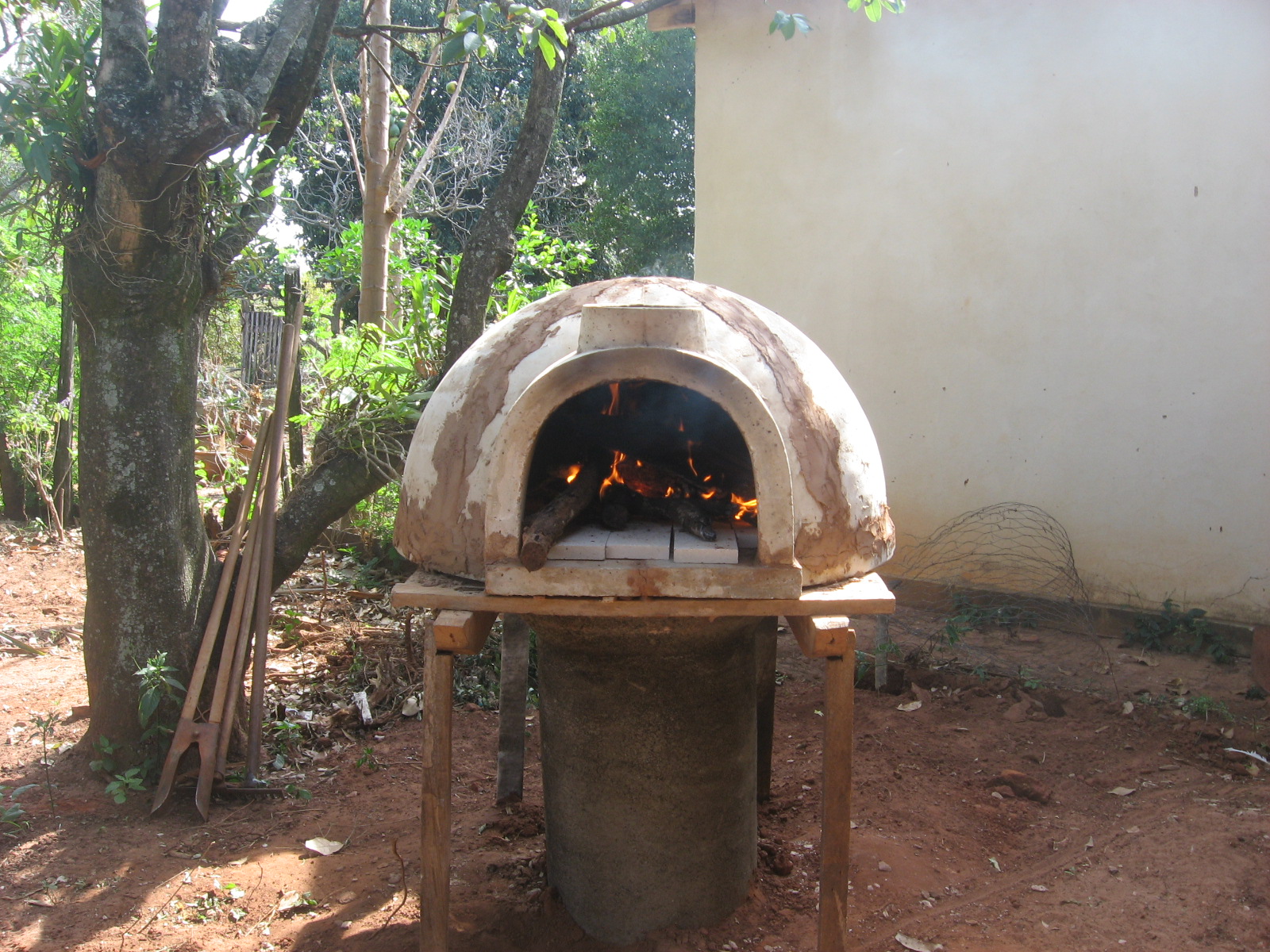
I had plans of building a brick oven using red earth as a mortar, just like many other cheap and common igloo-shaped ovens around here. But I remembered that the Baptist Church that runs an orphanage in the next town had an abandoned pre-molded oven. They once told me "it burned the bread". At that time, I thought that the oven was made with concrete. Only later I found out that they used a refractory concrete, which makes the oven perfectly usable. The same day I got the metal wood stove, I ran to the orphanage and asked for the oven. The pastor didn´t know the current price so couldn´t sell it right away. I had a price set on my mind, but for some reason, I had forgotten how much it costs in the store. A couple days later, I showed up and told him the price (R$390 for a brand new similar type). He sold me for R$150 and I offered him $20 extra to have it delivered the next day. I had also put a donation on my first visit. The whole adventure cost me R$210. But it doesn´t end there.
The anxiety of trying out the oven (to see if it really burns the bread) and eating a homemade pizza, I had the carpenters who are fixing up my house to set my oven just for that occasion.
I had rolled a heavy sewage concrete pipe to my yard and made a hole to hasten their job the following day. So they used red earth and cement as a mortar to glue the pieces together.
So, I made pizza not only once, but three times on my improvised oven stand. A few accidents happened, such as the wooden piece I had placed under the oven (without isolating it with bricks) caught on fire, the whole Calabrese sausage onion pizza fell upside down on the dirt and serving some uncooked burned pizza with ashes on top for guests who were in a hurry.
I got valuable lessons from it: can´t hurry the oven fire, can´t hurry the oven construction, and don´t walk around with a hot pan of Calabrese pizza.
My oven is still on an improvised stand, and I guess, it is going to be a few more days (or weeks) to have it in a permanent place, under a firm brick stand, over a concrete pad. I have also bought a big roll of fiberglass used in refrigerators to place it around the igloo to insulate the heat. We don´t use this material/technique in Brazil, but I have seen on youtube, so I decided to include it on my oven construction.
While I can´t use my igloo oven, I keep using my regular gas stove for baking. |
 The wood-fired oven is my latest passion. As a child, I used to see rustic brick made ovens in the countryside where women would make big free form loaves of bread. My mother never had one, the same way that she never made soaps, sausages, or cheese. All the nice things that were made back then.
A few weeks ago, my new tenant and I traded a piece of tractor equipment for this antique stove. He said that he got it from the local Catholic church, but I have no idea how this kind of stove ended up in our region. We have a very hot climate around here, and a metal stove that works as a heater is unwanted. It is of my knowledge that European descent people own this kind of appliance in the South, where it gets cold in the winter. My aunt told me that my grandmother used to have one. In Brazil, the brick made stove is the most common.
So I became curious about the metal stove and adopted it. But it came without a part of the chimney, which makes my baking almost impossible. Today, a woman from my church brought me a ceramic piece that may help to assemble the chimney. I am hoping for the best.
The wood-fired oven is my latest passion. As a child, I used to see rustic brick made ovens in the countryside where women would make big free form loaves of bread. My mother never had one, the same way that she never made soaps, sausages, or cheese. All the nice things that were made back then.
A few weeks ago, my new tenant and I traded a piece of tractor equipment for this antique stove. He said that he got it from the local Catholic church, but I have no idea how this kind of stove ended up in our region. We have a very hot climate around here, and a metal stove that works as a heater is unwanted. It is of my knowledge that European descent people own this kind of appliance in the South, where it gets cold in the winter. My aunt told me that my grandmother used to have one. In Brazil, the brick made stove is the most common.
So I became curious about the metal stove and adopted it. But it came without a part of the chimney, which makes my baking almost impossible. Today, a woman from my church brought me a ceramic piece that may help to assemble the chimney. I am hoping for the best.


