
Saturday, September 29, 2012
Tofu Making Experience


Friday, September 7, 2012
Frugal Living

Sunday, July 1, 2012
Nothing is All on Sundays

Friday, May 4, 2012
Life Never Left Us

Sunday, February 26, 2012
God´s Blessings in Our Lives Slideshow
You can also see at:
http://www.youtube.com/watch?v=qwHWQTJIaE0
So finally I got to take some pictures of my small town on a January Monday morning. The main avenue is usually very crowded with cars and pedestrians, specially on Saturdays were walking is a hassle, trying to swerve from slower people or even avoid bumping onto others that are standing up, chatting. Not very uncommon too is to find people that walk in groups, stopping all at once to see the shop windows. This particular morning was very calm, but even so, many people cross streets away from crosswalks. It is just part of their habits. I wanted to include scenes that I usually see - men drinking coffee in the morning while chatting to each other, retired men sitting on a park bench, dozens of bicycles speeding down the street, and other particularities that make this town alive. Nature pictures mostly taken on a farm, but some were taken elsewhere, but they all makes part of my life. For instance, I can't raise free range chickens as I lease our chicken coops for a large scale egg business. Foreign birds could bring diseases to thousand of chickens, reason why I gave away my tamed Guinea hens. The little chicks playing with the girls were also given away after a few days. The House - is freshly painted but no longer looks that tidy. Specially the farm kitchen where there is always something going on, such as sinkfull of dishes to be washed or a trail of flour all the way to the wood fired oven. The Food - I made them all - from scratch - except for the farmer's cheese that I buy from a neighbor. I got no cows. What really misses in pictures is the vibrant energy of all the processes. The bread was not made dark like that, but it started from addition of flour, water, yeast, salt, sugar. It had different body, texture, temperature - it was something else, to become what it did. This dynamic process where aroma and taste are released is a priviledge of those who can live near them. I often tell my daughter how lucky (or blessed) she is for having a mom who cooks, for living on a farm, for owning eight dogs, and for all we should be grateful.
Saturday, February 25, 2012
Baking Season


Two beautiful Fall days in the middle of Summer. Who can explain that? It’s darker in the morning around 7, but the evening is still long with daylight savings. The sun rays have the orange hue, different from Spring were the sparkling silver rays invade all rooms. The lack of natural beauty of our landscape on the farm makes me enjoy the sensation brought by other senses. I am lucky for that matter. I am not a visual person.
February is here. My 10-year-old daughter is back in school. I still have to drive her five days a week on a rather short drive (about 6 miles) on a flat and straight road, but dangerous due to drivers’ carelessness.
December and January were cooking, baking, eating months. Even though the doctor suspects I have gluten intolerance (no exams done), I baked several times a week using my newly assembled wood-fired oven. But the highlight was the church gathering day at my house. I tested several pizza dough recipes, watched the oven, learned to open the skin by hand until I found the best dough and the best way of serving piping hot pizza straight from the oven for several people. I didn’t know how many would come, so I planned for 30. I soon found out that I couldn’t open the skin and bake a raw crust to serve 30 hurried peopled at once. Too many issues involving the making of the perfect pizza, Neapolitan style. I had to compromise. I parbaked the crust a day before, topped 3 pizzas just 2 hours prior to serving, and hired a neighbor dona Rosa to take care of the baking. I took care of topping the pizza as the first ones got done. On my list, nine different combinations which included the all-American pepperoni or sausage, mushrooms, and bell peppers; also sliced smoked pork sausage with onions; ham, peas, onions, cooked eggs. All pizzas take tomato sauce (made with fresh and canned tomatoes) and mozzarella cheese. The event was a success, so much that I totally forgot to take a picture of the crowd around the pizza, all praising me with a full mouth, not knowing if they should speak or chew. I was as busy as a pizza maker on a ball day, topping on disk after the other. Later, I had to ask other people who ate what, who took the first piece, who had anchovy with olives. I sent home a few people with pizza for their family. “We had plenty. My husband ate, and even my mother-in-law” – someone told me.
I can't help myself but continue cooking, baking, soap making, and all. I also baked old fashioned English bread called scone to be dipped in lemon curd (it's a lemon season), Brazilian finger good called "empada" - little chicken pies, sweet rolls, broa (a country bread made in cooked corn and wheat flour, and later baked), Brazilian cheese bread, chocolate chip cookie, anise biscotti dipped in chocolate, whole wheat bread, and even "Artisan Bread in Five Minutes a Day" bread. And more pizzas, of course.
I can't post pictures of all my bakings, neither remember all that I cooked - there were so many goodies.
Monday, January 2, 2012
January 2nd, 2012 – Last Few Months
 In Brazil, Summer break starts sometime in December and it usually goes until after the Carnival – a religious holiday that transformed into a big national event. Being so, I don’t go to town twice a day as I used to, but I still need to run my errands a few times a week. With extra time on my hands, I started to walk on a road I used to run, a little less, as my dogs bark at motorcycles and even to cows belonging to somebody else. To avoid any situation, I interrupt my walk. They are so many (6) that I won’t have enough time to strain all of them before I leave. One Sunday before Christmas another puppy joined our pack. It was said to be a Pinscher Border Collie mix. To me, it is another mutt.
Every morning and every afternoon, I sit on my veranda chair to relax. The cool fresh morning air, contrasting with hot bitter coffee, I sit there enjoying myself. The dogs come to greet me, the puppy wants extra attention, and I raise my legs to a leg rest and rest. In the evening, after the sun has set, I also sit there remembering how much my back porch has improved. It used to be the portrait of a decadence. My father’s lack of financial resources to give it a little lift. After his death, I sold many farm equipment, as I decided to lease out the land instead of working on it (I tell the reasons later). With the money dripping in, I started to fix up the house, and after three months, I have the whole house fixed up and re-painted. Some areas such as the kitchen got a total makeover. I had the tile floor and wall changed, bought new appliances, and above all, took all the old stuff out of the house. My mother and sister used to oil paint canvas. We had several of them stored for decades. I hang them up on walls, making the house looking cheery. The biggest effect of the fixed up was the impression that it is not a dying place anymore. Yes, it had a solution for something that I thought could never happen. Sadly, it took my father’s death to make his inheritance take value. I live now in a newer, clean house. I didn’t have to make any major purchase, except for the kitchen, but lots of little ones made a difference. For instance, the drawer chests had a piece of fabric replacing the original knob since my childhood. I spent a few reais to buy new knobs on the furniture to take on a new look. Besides new painting giving an impression of clean walls, which were not only dirty but crumbling, the tiles cracked or simply missing on several spots in the house, the removal of old curtain tracks (yes, it was not a modern rod) for newer rods and curtains.
I had two men coming to do the job. They are dona Rosa’s brothers. During sugar cane harvest, they have work, but between September to March, they go unemployed. Even though they are not professional carpenters, they bravely took the job. Of course, many things were far from perfect, but I enjoyed the company. My biggest concern was to have a stranger working inside the house while I was out, but it turned out that they didn’t touch anything that shouldn’t be. They must come back to fix up the fence around the house – strangely, the fence was my first concern, but became the last one on the list.
Inside and outside of the house finished, including the set up of my wood-fired oven coated with red mud and cow’s fresh manure, I am working on my new interest: flower garden! I have already spent some to buy two palm trees and other plants. My main interest lays in forming a tropical garden with heliconias, bromeliads, ixoras. The plants that survived my mother’s illness (she used to have a very diverse plant material all over the garden, including a collection of orchids) were a few. Indeed they were sturdy, surviving lack of water or fertilizers over ten years. I felt sorrowful in eliminating what was there to give place to a whole new garden. I couldn’t cut down all the hibiscus, gardenia, dracaenas, rhododendron, zedoary, grass, hydrangea, ixora, bougainvillea, pata-de-vaca - a Brazilian native beautiful tree with perfumed white flower -, and many more, including a native berry tree. How could I make a beautiful landscape preserving all of those? After some research, I decided not to eliminate them, but crowding the spot with more plants, especially tropical ones, without any rigidity of a French garden, but rather more organic and natural – letting nature do it.
Lastly, my next upcoming project is to revive my organic vegetable garden. The old spot is full of weeds, dry, and rock hard. But it was once a lush garden, so it can be it again. This time, though, I am going to build a shade, as the sun is the inclement most part of the year and no leafy greens can survive.
The deep sadness that I feel with the loss of my father brought up new hope for living on the farm that I had once given up upon.
In Brazil, Summer break starts sometime in December and it usually goes until after the Carnival – a religious holiday that transformed into a big national event. Being so, I don’t go to town twice a day as I used to, but I still need to run my errands a few times a week. With extra time on my hands, I started to walk on a road I used to run, a little less, as my dogs bark at motorcycles and even to cows belonging to somebody else. To avoid any situation, I interrupt my walk. They are so many (6) that I won’t have enough time to strain all of them before I leave. One Sunday before Christmas another puppy joined our pack. It was said to be a Pinscher Border Collie mix. To me, it is another mutt.
Every morning and every afternoon, I sit on my veranda chair to relax. The cool fresh morning air, contrasting with hot bitter coffee, I sit there enjoying myself. The dogs come to greet me, the puppy wants extra attention, and I raise my legs to a leg rest and rest. In the evening, after the sun has set, I also sit there remembering how much my back porch has improved. It used to be the portrait of a decadence. My father’s lack of financial resources to give it a little lift. After his death, I sold many farm equipment, as I decided to lease out the land instead of working on it (I tell the reasons later). With the money dripping in, I started to fix up the house, and after three months, I have the whole house fixed up and re-painted. Some areas such as the kitchen got a total makeover. I had the tile floor and wall changed, bought new appliances, and above all, took all the old stuff out of the house. My mother and sister used to oil paint canvas. We had several of them stored for decades. I hang them up on walls, making the house looking cheery. The biggest effect of the fixed up was the impression that it is not a dying place anymore. Yes, it had a solution for something that I thought could never happen. Sadly, it took my father’s death to make his inheritance take value. I live now in a newer, clean house. I didn’t have to make any major purchase, except for the kitchen, but lots of little ones made a difference. For instance, the drawer chests had a piece of fabric replacing the original knob since my childhood. I spent a few reais to buy new knobs on the furniture to take on a new look. Besides new painting giving an impression of clean walls, which were not only dirty but crumbling, the tiles cracked or simply missing on several spots in the house, the removal of old curtain tracks (yes, it was not a modern rod) for newer rods and curtains.
I had two men coming to do the job. They are dona Rosa’s brothers. During sugar cane harvest, they have work, but between September to March, they go unemployed. Even though they are not professional carpenters, they bravely took the job. Of course, many things were far from perfect, but I enjoyed the company. My biggest concern was to have a stranger working inside the house while I was out, but it turned out that they didn’t touch anything that shouldn’t be. They must come back to fix up the fence around the house – strangely, the fence was my first concern, but became the last one on the list.
Inside and outside of the house finished, including the set up of my wood-fired oven coated with red mud and cow’s fresh manure, I am working on my new interest: flower garden! I have already spent some to buy two palm trees and other plants. My main interest lays in forming a tropical garden with heliconias, bromeliads, ixoras. The plants that survived my mother’s illness (she used to have a very diverse plant material all over the garden, including a collection of orchids) were a few. Indeed they were sturdy, surviving lack of water or fertilizers over ten years. I felt sorrowful in eliminating what was there to give place to a whole new garden. I couldn’t cut down all the hibiscus, gardenia, dracaenas, rhododendron, zedoary, grass, hydrangea, ixora, bougainvillea, pata-de-vaca - a Brazilian native beautiful tree with perfumed white flower -, and many more, including a native berry tree. How could I make a beautiful landscape preserving all of those? After some research, I decided not to eliminate them, but crowding the spot with more plants, especially tropical ones, without any rigidity of a French garden, but rather more organic and natural – letting nature do it.
Lastly, my next upcoming project is to revive my organic vegetable garden. The old spot is full of weeds, dry, and rock hard. But it was once a lush garden, so it can be it again. This time, though, I am going to build a shade, as the sun is the inclement most part of the year and no leafy greens can survive.
The deep sadness that I feel with the loss of my father brought up new hope for living on the farm that I had once given up upon.
Sunday, December 4, 2011
Fixing Up the House - December 4th, 2011

Life has taken precedence over writing the last few weeks. I have been very busy fixing up my house. It was a huge project, since my father could never keep up with the maintenance. He liked to do things by himself and not hire anyone, but the house was the last thing on his to do list.
We had a problem with rain water infiltration, which ended up creating mold on the ceiling and the walls. The walls were cracked, for the house had a problem with a foundation which got fixed, but the cracks remained for years. The tile floor had many missing pieces, and one of the worst problems were old appliances lined up in the kitchen. It was not only an unpleasant view of the house, but the cat was doing a bad job of keeping the mice away.
After my father’s death, with the fear of living just three women on the farm, I decided to change the kitchen doors that lead to the outside, as they were totally rusted, and one of them was being locked with an old belt. Slowly I asked them to do extra jobs, and ended up fixing up the whole house. They finished inside painting last week, and are still working on exterior.
It was a tremendous step for me, as fixing up the house (and spending all the money) means that I am to remain on the house and possibly, with the farm. The house now is the center of my life. I never took good care of any place I lived, as I always thought not to be permanent. When I was single and living in America, I spent the least money on decorating the home, always buying mismatched things at garage sales. Only when I got married and moved to a house, my husband allowed me to buy new furniture. I shopped many things at Ikea, to soon sell them all as we moved to Brazil. Here, we bought our first home, paying it off cash. Everything was new, but the marriage started to fall apart. Once again, we moved back to America, to Florida, this time. We had all used furniture again. Later, we financed a home, but the sparse furniture were the same. The only thing I did was to paint inside the house, using a technique I learned on TV. My bedroom resembled an old Tuscan home, with rusted golden color and unfinished wooden furniture. I loved the dark red with golden embroidery on a bed cover and on the curtains. I decorated the walls with black iron candle holder on the walls. Again, with the end of marriage, I sold them all. I returned to Brazil bringing only newly bought home appliances and some bed and bath items. Once settled in a small resort town I chose to live before I moved back with my parents, I furnished the house, spending again all the money I had brought.
The idea of settling myself here is starting to spring up in my mind. I feel happy and at peace. I have everything I need in this little town.
While I took away all the old kitchen appliances (3 refrigerators, 3 cabinets – actually one book shelf that worked as one, and a stove), three of six tables, and many more items, specially things that were cluttering the house, I hanged old canvas my mom and sister oil painted several decades ago. With a clean home, decorating it is an indescribable pleasure.
While before I was embarrassed to have people over, I now invite friends to visit me.
But my plans don’t end at finishing the house, but they extend to transform my yard into a nice garden. My plan is to transform part of the farm into “green savings” (plantation of trees for future wood harvest) and other part for reforestation. I will love to plant native trees, shrubs, herbs, flowers to be my own private forest. The reviving of the garden is in my mother’s honor, as she used to have a large collection of plants around of the house. Part of it died when she travel as seasonal worker to Japan and others died when she was unable to care for them. A very few plants have survived, and I am now wanting to run around to form a lush garden all over again.
Living on a farm is to live with living things. They always make me want to live another day, as if they depended on me.
Saturday, October 29, 2011
Portuguese Bread Folar
 Folar is an Easter bread that can be sweet or savory, depending upon the region of Portugal. What is different about this recipe is the incredible amount of eggs in the dough. The best thing is that it turns out light, fluffy, yet full of flavor, with a delicate crust that melts in the mouth.
The first time I heard about folar was at a hair salon. The lady taught me how to make this bread, and also paella with rabbit meat. I never got to make the paella her way, but I sure made folar a few times.
Over twenty years had passed, and here am I again making folar on an improved recipe I found on the internet at www.gastronomias.com. For those ones who cannot read Portuguese, I shall translate it for you with my own personal twist (and experience). This is a great recipe.
1 kg all-purpose flour
12 eggs (yes, 12!) with shells warmed in warm water before breaking
250g melted butter
50g olive oil
30g compressed fresh yeast melted in ¼ cup warm water
Warm milk and salt
Smoked sausage sliced, salt pork or bacon cut into small cubes, ham, roasted chicken
In a large bowl, make a well in the center of the flour. Pour melted yeast and eggs, mixing in a circle, adding the flour little by little. Add butter and oil. If the dough is stiff, add a little bit of warm milk with salt to taste. It´s a soft dough, so you do more beating kind of movement than kneading until it forms a ball. Let it rise.
The recipe instructs to divide the dough into 3 and make layers (like lasagna) with meat. Let it rise again, and then, brush with egg wash, and bake in a hot oven for 45 minutes.
I have done it differently. I was so tired and sleepy that night that I stashed into the fridge until the next morning. I took it out of the fridge, kneaded a bit, and stretched with a hand roller. I cut the dough into 2, opened it like a pizza crust, and spread the meat over. I rolled it (like would sushi), tucked the sides underneath, and let it rise. Over two hours later, and with the dough risen greatly, I popped them in a hot oven for about 30 minutes. I lowed the temperature a bit, so as not to burn. They came out huge, light, fluffy, and tasty.
The next day I used the same recipe and process, but filled with provolone cheese and the other piece with green olives. I can’t say which one is the best.
Folar is an Easter bread that can be sweet or savory, depending upon the region of Portugal. What is different about this recipe is the incredible amount of eggs in the dough. The best thing is that it turns out light, fluffy, yet full of flavor, with a delicate crust that melts in the mouth.
The first time I heard about folar was at a hair salon. The lady taught me how to make this bread, and also paella with rabbit meat. I never got to make the paella her way, but I sure made folar a few times.
Over twenty years had passed, and here am I again making folar on an improved recipe I found on the internet at www.gastronomias.com. For those ones who cannot read Portuguese, I shall translate it for you with my own personal twist (and experience). This is a great recipe.
1 kg all-purpose flour
12 eggs (yes, 12!) with shells warmed in warm water before breaking
250g melted butter
50g olive oil
30g compressed fresh yeast melted in ¼ cup warm water
Warm milk and salt
Smoked sausage sliced, salt pork or bacon cut into small cubes, ham, roasted chicken
In a large bowl, make a well in the center of the flour. Pour melted yeast and eggs, mixing in a circle, adding the flour little by little. Add butter and oil. If the dough is stiff, add a little bit of warm milk with salt to taste. It´s a soft dough, so you do more beating kind of movement than kneading until it forms a ball. Let it rise.
The recipe instructs to divide the dough into 3 and make layers (like lasagna) with meat. Let it rise again, and then, brush with egg wash, and bake in a hot oven for 45 minutes.
I have done it differently. I was so tired and sleepy that night that I stashed into the fridge until the next morning. I took it out of the fridge, kneaded a bit, and stretched with a hand roller. I cut the dough into 2, opened it like a pizza crust, and spread the meat over. I rolled it (like would sushi), tucked the sides underneath, and let it rise. Over two hours later, and with the dough risen greatly, I popped them in a hot oven for about 30 minutes. I lowed the temperature a bit, so as not to burn. They came out huge, light, fluffy, and tasty.
The next day I used the same recipe and process, but filled with provolone cheese and the other piece with green olives. I can’t say which one is the best.
Getting the Real Thing
 When I first took an interest in country-style bread baked in a wood-fired oven, I asked my neighbor that I barely knew to teach me the secrets of the trade. I was after the type of bread stored in my childhood memories that tasted much different from the bread I eat today, even if baked in wood-fired ovens. Dona Rosa, then, told me that her sister who lives several miles away had “yeast in a bottle”.
A few days ago, I put in a bag a package of cookies, flour, and sugar (these were to be given as gifts), picked up Dona Rosa, and headed for her sister´s house. She lives in a very small rural community of dozen homes in a rather scenic route. I used to drive this road while taking “Pro-Milk”, a course to learn how to work with milking cows.
We were greeted by four women, an elderly lady, two middle-aged women, and a teenager. The older lady is Dona Rosa´s mother who is already a great-great-grandmother. Dona Rosa herself turned a great-grandmother at the age of 50. Anyway, we all seated on the sofa and they talked about people’s state of health. I tried to be interested but my mind wondered how soon I was going to see the starter. I noticed that the wood walls looked grungy, as my mom used to say the wood houses always look dirty and dark. Sometimes it holds a smell. At a certain point, the lady announced that she would make some coffee and disappeared into the kitchen. About thirty minutes later, she invited us to sit at the table.
She served us two plain deep-fried dough. Davina said that the first one was made of flour, water, and baking powder. The second one was made with a sourdough starter, “so I could see the difference”. Anything fried makes just flour and water taste delicious. Some were puffed up, but they had no filling.
Over an hour and still no signs of the starter. Only when everybody was finished, included some family members that joined us later that Davina took the prized starter from the fridge, kept in a 1-liter Coke plastic bottle. About one inch of flour on the bottom, and 500 ml of liquid. It was inert, no bubbles or foam. It looked flat and watery. She gave me the recipe to feed the starter: 9 tablespoons of flour, 3 tablespoons of sugar, and 1 teaspoon of salt. She omits the type of spoon, so on my first experience, I added too much salt.
The great day came; I treated my starter, took half for the bread, and kept half in the fridge. The bread recipe was 2 kg flour, 500 or 600 ml starter, less than a cup of oil, some water, sugar, and salt. The dough came out very stiff, but I didn’t know how it was supposed to be. So I added more starter and oil. I left the dough rest for the night, punched it down the next morning, stretched the dough with a hand roller, and free-formed them. Another few hours until they went to Dona Rosa’s wood-fired oven.
The bread smelled like sweet yeast (if this thing exists), it tasted slightly sour, but not quite like California sourdough bread. The density and the texture, besides the pale color of the crust, definitely I can tell that I have reproduced the bread of my childhood.
The bread became better with further bakings, and I have used the starter to make a deep-fried dough and also pizza crust. I thought to be a mix of tough and chewy crust, but the taste had character. Something to become addicted to. The next day, I heated over a dry pan and the crust became crunch and even more delicious.
I am still to try sourdough pancakes and guava paste filled fried dough.
Yeah, I dumped the two other starters I had made at home from scratch. They were too sour, almost offensive. To taste, the “yeast in a bottle” is sweet and mild. Interestingly, it rises better in a tall narrow container. When kept tightly closed in a bottle, at the opening, it may burst like champagne. How fun!
When I first took an interest in country-style bread baked in a wood-fired oven, I asked my neighbor that I barely knew to teach me the secrets of the trade. I was after the type of bread stored in my childhood memories that tasted much different from the bread I eat today, even if baked in wood-fired ovens. Dona Rosa, then, told me that her sister who lives several miles away had “yeast in a bottle”.
A few days ago, I put in a bag a package of cookies, flour, and sugar (these were to be given as gifts), picked up Dona Rosa, and headed for her sister´s house. She lives in a very small rural community of dozen homes in a rather scenic route. I used to drive this road while taking “Pro-Milk”, a course to learn how to work with milking cows.
We were greeted by four women, an elderly lady, two middle-aged women, and a teenager. The older lady is Dona Rosa´s mother who is already a great-great-grandmother. Dona Rosa herself turned a great-grandmother at the age of 50. Anyway, we all seated on the sofa and they talked about people’s state of health. I tried to be interested but my mind wondered how soon I was going to see the starter. I noticed that the wood walls looked grungy, as my mom used to say the wood houses always look dirty and dark. Sometimes it holds a smell. At a certain point, the lady announced that she would make some coffee and disappeared into the kitchen. About thirty minutes later, she invited us to sit at the table.
She served us two plain deep-fried dough. Davina said that the first one was made of flour, water, and baking powder. The second one was made with a sourdough starter, “so I could see the difference”. Anything fried makes just flour and water taste delicious. Some were puffed up, but they had no filling.
Over an hour and still no signs of the starter. Only when everybody was finished, included some family members that joined us later that Davina took the prized starter from the fridge, kept in a 1-liter Coke plastic bottle. About one inch of flour on the bottom, and 500 ml of liquid. It was inert, no bubbles or foam. It looked flat and watery. She gave me the recipe to feed the starter: 9 tablespoons of flour, 3 tablespoons of sugar, and 1 teaspoon of salt. She omits the type of spoon, so on my first experience, I added too much salt.
The great day came; I treated my starter, took half for the bread, and kept half in the fridge. The bread recipe was 2 kg flour, 500 or 600 ml starter, less than a cup of oil, some water, sugar, and salt. The dough came out very stiff, but I didn’t know how it was supposed to be. So I added more starter and oil. I left the dough rest for the night, punched it down the next morning, stretched the dough with a hand roller, and free-formed them. Another few hours until they went to Dona Rosa’s wood-fired oven.
The bread smelled like sweet yeast (if this thing exists), it tasted slightly sour, but not quite like California sourdough bread. The density and the texture, besides the pale color of the crust, definitely I can tell that I have reproduced the bread of my childhood.
The bread became better with further bakings, and I have used the starter to make a deep-fried dough and also pizza crust. I thought to be a mix of tough and chewy crust, but the taste had character. Something to become addicted to. The next day, I heated over a dry pan and the crust became crunch and even more delicious.
I am still to try sourdough pancakes and guava paste filled fried dough.
Yeah, I dumped the two other starters I had made at home from scratch. They were too sour, almost offensive. To taste, the “yeast in a bottle” is sweet and mild. Interestingly, it rises better in a tall narrow container. When kept tightly closed in a bottle, at the opening, it may burst like champagne. How fun!
Saturday, October 15, 2011
Brazilian Soap Recipe & Process
Soapmaking is a simple process, but rather dangerous. I wouldn´t recommend just to anyone. Only people that feel safe in handling boiling elements can take on a project like this. In this video, I wanted just to show you how I make one of my household use soaps; it is not intended to teach you to make one. There is no space for detailed orientation in the video, nor have I enough knowledge to instruct you on a safe soapmaking process. The alcohol based soaps trace very quickly, specially when added to tallow. The most dangerous mixture is the use of too warm lye mixture, too warm tallow, an alcohol. The soap mixture boils over as soon as it traces, leaving a pool of raw soap on the floor. If you noticed, you will see the angry fumes going up after doing the spoon test. It boiled over, you will see next to the tray. I was able to pour it afterwards, but lost quite a bit of useable soap. The foam that hardens also cleans well - so, no need to cut it away. I like using the bar soap on dishes, but I boil grated soap in water to use in laundry machine. I don´t believe to be good to be used on dishwashing machine (I don´t have one). Of course, I start using the soap when it turns white (cured), at least partially. Raw soap that catches on a bucket is used to soak kitchen towels or rags. I love making this soap for several reasons: it traces in a matter of seconds; it never goes wrong; it yields beautiful, uniform, smooth soap; it cleans like no other; no residual smell of animal fat; it dries and hardens fast; it´s a winner.
October 11, 2011 - My Very First Sourdough Bread

 My Very First Sourdough Bread
I am diving deep into the rural culture of doing everything from scratch. After the experience of baking pizza in my new wood-fired oven, I took interest in the wild yeast fermentation process, the .sourdough starter.
Most of the time, my only door to the outside world is the internet. I researched all I could to learn the process. It is rather a very easy thing, just like soapmaking.
I began with two different recipes, one that I followed more closely, and the other one that I ended up doing my way – both turned out OK. In the first days, neither mixture would show anything except slight deterioration. The chef James Beard´s recipe called for flour, sugar, milk, water, and later on, a package of dry commercial yeast. As I had only instant dry yeast, I used compressed fresh yeast. The mixture never really bubbled, looking more like yogurt, even though it smelled like good beer. The other mixture I used just flour and water, and it looked flat, lifeless until I decided to feed more flour. Then, it started to foam. Unlike others I have seen on the internet that make large bubbles, even on the bottom of the container, mine was foamy only on top, but sticky all through.
After seven days or so, I prepared Beard´s recipe. For the bread dough itself, he calls for a package of active dry yeast, which I didn´t have (I found only the instant one or the compressed kind in the store), so I was forced to use the instant yeast, as the compressed had green mold on it. It took a rise, a punch down, another rise, and then to shape it into a roll. I think my problem started at this point, as the end result was a flat, dense, slightly raw tasting bread, which ended up tasting deliciously tangy, with a dry thick crust on top and smushy bottom. First, I left the dough rise too long for the type of yeast after I shaped it. The dough opened on the top, showing some bubbles. Then, it suffered from the low-temperature oven, which instead of baking in 30 minutes, took over an hour. I was so dismayed that I would have gone to town to buy a good stove just to bake my other bread tomorrow. But tomorrow is a holiday and all stores are closed.
Meanwhile, the other dough is still left to rise. I am soon going to punch down and mold it into a free form and tomorrow, to see how it tastes. I am most curious about this one as it doesn´t have any commercial yeast, and the dough rose wonderfully.
I am going to ask my neighbors to help me bake my bread in their wood-fired oven. Or I will lose my hard-worked dough. After all, for this one, it is going to be 10 days of watching, caring, kneading, and expecting.
My Very First Sourdough Bread
I am diving deep into the rural culture of doing everything from scratch. After the experience of baking pizza in my new wood-fired oven, I took interest in the wild yeast fermentation process, the .sourdough starter.
Most of the time, my only door to the outside world is the internet. I researched all I could to learn the process. It is rather a very easy thing, just like soapmaking.
I began with two different recipes, one that I followed more closely, and the other one that I ended up doing my way – both turned out OK. In the first days, neither mixture would show anything except slight deterioration. The chef James Beard´s recipe called for flour, sugar, milk, water, and later on, a package of dry commercial yeast. As I had only instant dry yeast, I used compressed fresh yeast. The mixture never really bubbled, looking more like yogurt, even though it smelled like good beer. The other mixture I used just flour and water, and it looked flat, lifeless until I decided to feed more flour. Then, it started to foam. Unlike others I have seen on the internet that make large bubbles, even on the bottom of the container, mine was foamy only on top, but sticky all through.
After seven days or so, I prepared Beard´s recipe. For the bread dough itself, he calls for a package of active dry yeast, which I didn´t have (I found only the instant one or the compressed kind in the store), so I was forced to use the instant yeast, as the compressed had green mold on it. It took a rise, a punch down, another rise, and then to shape it into a roll. I think my problem started at this point, as the end result was a flat, dense, slightly raw tasting bread, which ended up tasting deliciously tangy, with a dry thick crust on top and smushy bottom. First, I left the dough rise too long for the type of yeast after I shaped it. The dough opened on the top, showing some bubbles. Then, it suffered from the low-temperature oven, which instead of baking in 30 minutes, took over an hour. I was so dismayed that I would have gone to town to buy a good stove just to bake my other bread tomorrow. But tomorrow is a holiday and all stores are closed.
Meanwhile, the other dough is still left to rise. I am soon going to punch down and mold it into a free form and tomorrow, to see how it tastes. I am most curious about this one as it doesn´t have any commercial yeast, and the dough rose wonderfully.
I am going to ask my neighbors to help me bake my bread in their wood-fired oven. Or I will lose my hard-worked dough. After all, for this one, it is going to be 10 days of watching, caring, kneading, and expecting.
Sunday, October 2, 2011
October 2, 2011 - Pizza Passion Or Oven Anxiety
 |
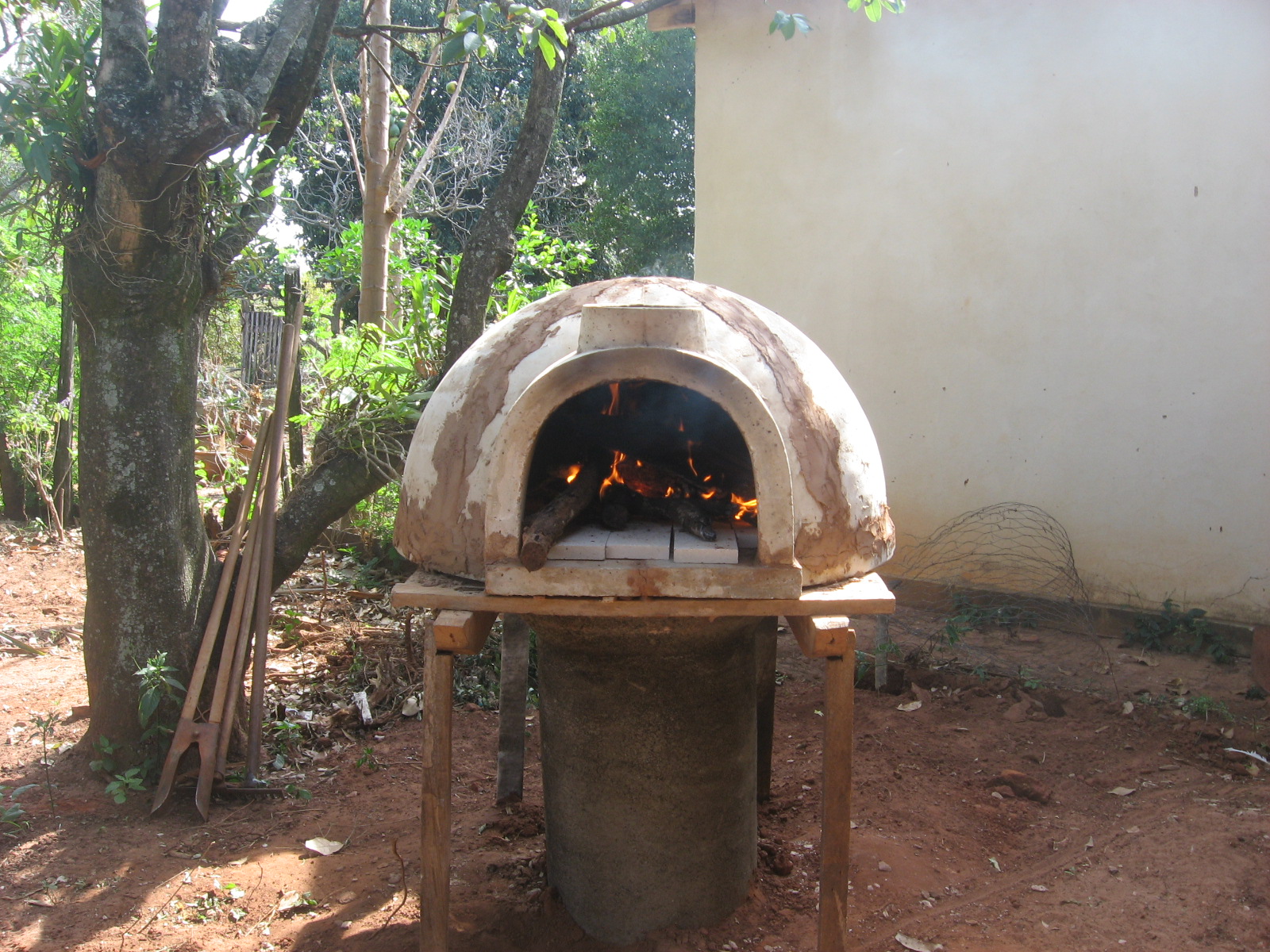
I had plans of building a brick oven using red earth as a mortar, just like many other cheap and common igloo-shaped ovens around here. But I remembered that the Baptist Church that runs an orphanage in the next town had an abandoned pre-molded oven. They once told me "it burned the bread". At that time, I thought that the oven was made with concrete. Only later I found out that they used a refractory concrete, which makes the oven perfectly usable. The same day I got the metal wood stove, I ran to the orphanage and asked for the oven. The pastor didn´t know the current price so couldn´t sell it right away. I had a price set on my mind, but for some reason, I had forgotten how much it costs in the store. A couple days later, I showed up and told him the price (R$390 for a brand new similar type). He sold me for R$150 and I offered him $20 extra to have it delivered the next day. I had also put a donation on my first visit. The whole adventure cost me R$210. But it doesn´t end there.
The anxiety of trying out the oven (to see if it really burns the bread) and eating a homemade pizza, I had the carpenters who are fixing up my house to set my oven just for that occasion.
I had rolled a heavy sewage concrete pipe to my yard and made a hole to hasten their job the following day. So they used red earth and cement as a mortar to glue the pieces together.
So, I made pizza not only once, but three times on my improvised oven stand. A few accidents happened, such as the wooden piece I had placed under the oven (without isolating it with bricks) caught on fire, the whole Calabrese sausage onion pizza fell upside down on the dirt and serving some uncooked burned pizza with ashes on top for guests who were in a hurry.
I got valuable lessons from it: can´t hurry the oven fire, can´t hurry the oven construction, and don´t walk around with a hot pan of Calabrese pizza.
My oven is still on an improvised stand, and I guess, it is going to be a few more days (or weeks) to have it in a permanent place, under a firm brick stand, over a concrete pad. I have also bought a big roll of fiberglass used in refrigerators to place it around the igloo to insulate the heat. We don´t use this material/technique in Brazil, but I have seen on youtube, so I decided to include it on my oven construction.
While I can´t use my igloo oven, I keep using my regular gas stove for baking. |
October 2, 2011 - Wood Stove
 The wood-fired oven is my latest passion. As a child, I used to see rustic brick made ovens in the countryside where women would make big free form loaves of bread. My mother never had one, the same way that she never made soaps, sausages, or cheese. All the nice things that were made back then.
A few weeks ago, my new tenant and I traded a piece of tractor equipment for this antique stove. He said that he got it from the local Catholic church, but I have no idea how this kind of stove ended up in our region. We have a very hot climate around here, and a metal stove that works as a heater is unwanted. It is of my knowledge that European descent people own this kind of appliance in the South, where it gets cold in the winter. My aunt told me that my grandmother used to have one. In Brazil, the brick made stove is the most common.
So I became curious about the metal stove and adopted it. But it came without a part of the chimney, which makes my baking almost impossible. Today, a woman from my church brought me a ceramic piece that may help to assemble the chimney. I am hoping for the best.
The wood-fired oven is my latest passion. As a child, I used to see rustic brick made ovens in the countryside where women would make big free form loaves of bread. My mother never had one, the same way that she never made soaps, sausages, or cheese. All the nice things that were made back then.
A few weeks ago, my new tenant and I traded a piece of tractor equipment for this antique stove. He said that he got it from the local Catholic church, but I have no idea how this kind of stove ended up in our region. We have a very hot climate around here, and a metal stove that works as a heater is unwanted. It is of my knowledge that European descent people own this kind of appliance in the South, where it gets cold in the winter. My aunt told me that my grandmother used to have one. In Brazil, the brick made stove is the most common.
So I became curious about the metal stove and adopted it. But it came without a part of the chimney, which makes my baking almost impossible. Today, a woman from my church brought me a ceramic piece that may help to assemble the chimney. I am hoping for the best.
October 1st, 2011 - Spring is in the Air!
 My enthusiasm is back around farm living, after a few months of discouragement. If you remember, my father decided to sell the farm for I had decided to go back to my city life somewhere in America. I was heartbroken, and all I wanted was to find my self-worth elsewhere. In the midst of all of this, my father suddenly got ill and passed away. My brother came from America on a quick trip basically to tell me that he wanted nothing to do with the farm and left. My sister didn't want to take our bedridden mom to Sao Paulo city into her tiny apartment. But I had already decided to stay, take care of my mother, and fight to get my heart healed now for two big losses. So the adventures on the farm continue in this hot and dry beginning of Spring.
A big era ended in my life - of care-free living. I finally grew to be an adult? I took over the farm; I am now solely responsible for my mother's care and still having to raise a 10-year old girl. I have six dogs, four of them I chose to adopt in the last three years, and a male cat left by my father.
Many people got afraid for me as we are just three women - a frail elderly, a child, and myself - living in a rural area, where violent crimes have been reported. But I chose to remain on the farm and I chose not to be ridden by fear. I had an alarm system installed in the house and am careful to come in and out. I have studied adopting a more aggressive dog such as Rotweiller, but I am unsure about my authority over him.
I was able to rent the pasture and with it, I got all the fencing fixed. With the cows eating the tall grass, the danger of fire also diminishes. Today I witnessed two blazing spots and two other smoky patches along the road within a few miles from the farm. That was scary. But we are expecting rain for the next few days, and this should ameliorate the situation.
The pasture rental doesn´t pay me much; of course, much less than if I had a cattle myself. But it is so worry-free that I actually like that I can make money doing nothing. The renter is a successful vegetable grower in town. I had met him a couple years ago and from whom I got my crazy Border Collie mix.
The chicken coop is still being rented to the same man for years. Nothing changed. Now, I have only the coffee plantation section to be taken care of. I know that I may get even less than renting a pasture, but at least, someone will care for what my father put so much work, money, and efforts. A neighbor told me that my father confessed to him "I know that I am not going to live another 50 years. I am working hard to leave the farm productive for my daughter." I am so sorry I can't harvest coffee another year. It takes investments and human labor I am not apt to work with. My only option besides selling the farm would be to rent them out. That's what I am doing. I feel somewhat ashamed to tell that I didn't choose to fight against the odds and throwing myself into rural entrepreneurship.
When we think about the differences between city and farm living, immediately comes to one´s mind the tranquility of the bucolic lifestyle one can have on a farm. It is still true, but to me, the brutal difference is that the city skills that I have are almost of no use here. It´s a whole new way of thinking and solving problems. Being a woman, I get no much respect from employees who are used to deal with male bosses, when we get to hire any. A man who was fixing the fence works for my tenant, and I wanted to hire him to do the fence around my house. Even though this worker knows me, he just disappeared into a thin air. My tenant told me of this man´s resistance to work for a woman, even though he offered to give him a ride every day and assist him in fence building. During harvest, I would have to deal with at least six to fifteen people, many of the men. I am supposed to be the old fashioned authoritarian boss, but I was educated to be democratic. Of course, there is a difference between being a good leader and a weak one, but it is not part of my personality to force one into doing something. The rural workers are the rejected ones from the workforce for lack of education and skills. Those aspects also make them very difficult to deal with. I have a temporary worker who does little jobs for me who is completely illiterate. He doesn´t sign his name, doesn´t read clock hours, and doesn´t know money. Thank God he is a docile man that resembles much the gardener played by Peter Seller´s in "Being There" or "The Idiot", a Dostoevsky´s character. Of course, instructions are almost useless. He doesn´t understand them, especially if I give him a sequence of work. I need to work side by side, so the work progresses.
The farm is about 40 acres, divided into chicken coops, coffee plantation, the pasture, and the house. So my new playground is the house and the surrounding area. It is still pretty large. I have an orchard, a space for vegetable gardening, a front yard for the flower garden and so much more.
If I sold the farm, I would get only a house the size I have now in town. Right now, I have electricity and water included in my tenant's account; I have several fruit trees I planted a couple years ago. Some of them I have been already harvesting fruits. I prize also the silence and solitude in the countryside. But I don't feel isolated. I drive to town twice a day, a house helper comes every morning, I chat with my neighbor almost every day. And, I have internet access - that's my door to the world. Besides, I always find something of my interest to develop.
I am working to turn my dream into reality: to have a wood-fired oven; my house fixed up; to build a rustic sauna and a hot tub. My latest interest is a sourdough starter! Today I baked rosemary focaccia in my regular gas stove. But I have tried my second hand purchased pre-molded oven with pizza making. Also, I bought a very old metal stove, wood burning, and have tried to bake some. But the lack of a chimney makes the oven cool quickly, so I have put it aside for a while.
This is the scenery of my current farm life. I am not growing vegetables, raising free-range chickens, pigs, or cows. I only have pets. The great part of income comes from my father´s pension and my mother´s retirement, besides the child support money. A smaller amount comes from the lease. I don´t have a single thing that comes from the land that I turn into money. Or no food that I feed myself on. I feel like I have a suburban lifestyle.
I am trying to figure out if I am a fake or not, or if I have succumbed to a new economic reality in my country. I can´t survive out of the small land. I don´t have a large family, the skills, the bank loan, or government support. I could get knowledge (as I have been getting through classes), but knowledge alone won´t plow the land. More on this subject sometime later.
I just came to say that I am well, happy, with many projects and I want to share them with you.
Have a great Spring! - at least here, down the Equator.
My enthusiasm is back around farm living, after a few months of discouragement. If you remember, my father decided to sell the farm for I had decided to go back to my city life somewhere in America. I was heartbroken, and all I wanted was to find my self-worth elsewhere. In the midst of all of this, my father suddenly got ill and passed away. My brother came from America on a quick trip basically to tell me that he wanted nothing to do with the farm and left. My sister didn't want to take our bedridden mom to Sao Paulo city into her tiny apartment. But I had already decided to stay, take care of my mother, and fight to get my heart healed now for two big losses. So the adventures on the farm continue in this hot and dry beginning of Spring.
A big era ended in my life - of care-free living. I finally grew to be an adult? I took over the farm; I am now solely responsible for my mother's care and still having to raise a 10-year old girl. I have six dogs, four of them I chose to adopt in the last three years, and a male cat left by my father.
Many people got afraid for me as we are just three women - a frail elderly, a child, and myself - living in a rural area, where violent crimes have been reported. But I chose to remain on the farm and I chose not to be ridden by fear. I had an alarm system installed in the house and am careful to come in and out. I have studied adopting a more aggressive dog such as Rotweiller, but I am unsure about my authority over him.
I was able to rent the pasture and with it, I got all the fencing fixed. With the cows eating the tall grass, the danger of fire also diminishes. Today I witnessed two blazing spots and two other smoky patches along the road within a few miles from the farm. That was scary. But we are expecting rain for the next few days, and this should ameliorate the situation.
The pasture rental doesn´t pay me much; of course, much less than if I had a cattle myself. But it is so worry-free that I actually like that I can make money doing nothing. The renter is a successful vegetable grower in town. I had met him a couple years ago and from whom I got my crazy Border Collie mix.
The chicken coop is still being rented to the same man for years. Nothing changed. Now, I have only the coffee plantation section to be taken care of. I know that I may get even less than renting a pasture, but at least, someone will care for what my father put so much work, money, and efforts. A neighbor told me that my father confessed to him "I know that I am not going to live another 50 years. I am working hard to leave the farm productive for my daughter." I am so sorry I can't harvest coffee another year. It takes investments and human labor I am not apt to work with. My only option besides selling the farm would be to rent them out. That's what I am doing. I feel somewhat ashamed to tell that I didn't choose to fight against the odds and throwing myself into rural entrepreneurship.
When we think about the differences between city and farm living, immediately comes to one´s mind the tranquility of the bucolic lifestyle one can have on a farm. It is still true, but to me, the brutal difference is that the city skills that I have are almost of no use here. It´s a whole new way of thinking and solving problems. Being a woman, I get no much respect from employees who are used to deal with male bosses, when we get to hire any. A man who was fixing the fence works for my tenant, and I wanted to hire him to do the fence around my house. Even though this worker knows me, he just disappeared into a thin air. My tenant told me of this man´s resistance to work for a woman, even though he offered to give him a ride every day and assist him in fence building. During harvest, I would have to deal with at least six to fifteen people, many of the men. I am supposed to be the old fashioned authoritarian boss, but I was educated to be democratic. Of course, there is a difference between being a good leader and a weak one, but it is not part of my personality to force one into doing something. The rural workers are the rejected ones from the workforce for lack of education and skills. Those aspects also make them very difficult to deal with. I have a temporary worker who does little jobs for me who is completely illiterate. He doesn´t sign his name, doesn´t read clock hours, and doesn´t know money. Thank God he is a docile man that resembles much the gardener played by Peter Seller´s in "Being There" or "The Idiot", a Dostoevsky´s character. Of course, instructions are almost useless. He doesn´t understand them, especially if I give him a sequence of work. I need to work side by side, so the work progresses.
The farm is about 40 acres, divided into chicken coops, coffee plantation, the pasture, and the house. So my new playground is the house and the surrounding area. It is still pretty large. I have an orchard, a space for vegetable gardening, a front yard for the flower garden and so much more.
If I sold the farm, I would get only a house the size I have now in town. Right now, I have electricity and water included in my tenant's account; I have several fruit trees I planted a couple years ago. Some of them I have been already harvesting fruits. I prize also the silence and solitude in the countryside. But I don't feel isolated. I drive to town twice a day, a house helper comes every morning, I chat with my neighbor almost every day. And, I have internet access - that's my door to the world. Besides, I always find something of my interest to develop.
I am working to turn my dream into reality: to have a wood-fired oven; my house fixed up; to build a rustic sauna and a hot tub. My latest interest is a sourdough starter! Today I baked rosemary focaccia in my regular gas stove. But I have tried my second hand purchased pre-molded oven with pizza making. Also, I bought a very old metal stove, wood burning, and have tried to bake some. But the lack of a chimney makes the oven cool quickly, so I have put it aside for a while.
This is the scenery of my current farm life. I am not growing vegetables, raising free-range chickens, pigs, or cows. I only have pets. The great part of income comes from my father´s pension and my mother´s retirement, besides the child support money. A smaller amount comes from the lease. I don´t have a single thing that comes from the land that I turn into money. Or no food that I feed myself on. I feel like I have a suburban lifestyle.
I am trying to figure out if I am a fake or not, or if I have succumbed to a new economic reality in my country. I can´t survive out of the small land. I don´t have a large family, the skills, the bank loan, or government support. I could get knowledge (as I have been getting through classes), but knowledge alone won´t plow the land. More on this subject sometime later.
I just came to say that I am well, happy, with many projects and I want to share them with you.
Have a great Spring! - at least here, down the Equator.
Thursday, August 18, 2011
Sweet Passionfruit

 Of course, my mom didn´t allow us to take anything that didn´t belong to us. But I did. I took two green sweet passionfruit and hid them in a cool and dark spot. As it was my usual spot to play, after a few days, unexpectedly, I found them totally ripe and...sweet. So I learned that green fruit may become ripe away from its tree - it was unknown to me. A big finding for someone who only picked ripe fruits.
Even though we may find sweet passionfruit growing in many places, it is not largely sold in markets. After that episode, I ate again many years later, bought at the produce market in Sao Paulo city. In America? I don´t remember having eaten any, so whenever I came to visit, I would buy several and gorge on them. As a matter of fact, the edible part is the jelly-like pulp and the seeds. We don´t chew seeds, or they will sour your mouth.
This kind of passionfruit is eaten as a fruit, different from the "juice kind" which is rounder and pale yellow, and easily found in the market. The juice kind is sour, yet, very popular for juice making. You will need to mix with water and lots of sugar, just like lemonade. You may try to mix the pure juice with cold black tea and sweetened condensed milk. It´s a deep, smoky, creamy, sweet with a hint of acidity and very fragrant drink that it is almost a dessert by itself.
Brazilians like to use passionfruit (the juice kind) to make mousses, jello, creams, you name it. Use it as would a lemon. Just sieve the juice and discard seeds. For juice, blend together the pulp with seeds, sugar, and cold water. It is known to have a very calming effect. There is even some herbal medicine made from it.
If you want to see its beautiful exotic looking flower, please check May 17, 2010 - April Reviewed blog.
Of course, my mom didn´t allow us to take anything that didn´t belong to us. But I did. I took two green sweet passionfruit and hid them in a cool and dark spot. As it was my usual spot to play, after a few days, unexpectedly, I found them totally ripe and...sweet. So I learned that green fruit may become ripe away from its tree - it was unknown to me. A big finding for someone who only picked ripe fruits.
Even though we may find sweet passionfruit growing in many places, it is not largely sold in markets. After that episode, I ate again many years later, bought at the produce market in Sao Paulo city. In America? I don´t remember having eaten any, so whenever I came to visit, I would buy several and gorge on them. As a matter of fact, the edible part is the jelly-like pulp and the seeds. We don´t chew seeds, or they will sour your mouth.
This kind of passionfruit is eaten as a fruit, different from the "juice kind" which is rounder and pale yellow, and easily found in the market. The juice kind is sour, yet, very popular for juice making. You will need to mix with water and lots of sugar, just like lemonade. You may try to mix the pure juice with cold black tea and sweetened condensed milk. It´s a deep, smoky, creamy, sweet with a hint of acidity and very fragrant drink that it is almost a dessert by itself.
Brazilians like to use passionfruit (the juice kind) to make mousses, jello, creams, you name it. Use it as would a lemon. Just sieve the juice and discard seeds. For juice, blend together the pulp with seeds, sugar, and cold water. It is known to have a very calming effect. There is even some herbal medicine made from it.
If you want to see its beautiful exotic looking flower, please check May 17, 2010 - April Reviewed blog.
Friday, August 12, 2011
Green Bananas
 Banana is the most popular and the cheapest fruit in Brazil. We appreciate it in several ways, raw, cooked, baked, grilled, ripe, or green. Yes, green bananas can be made into chips. But the latest findings came from Universidade Estadual do Rio Grande do Norte where researchers claim that a certain substance (inulin) in the green banana helps the digestion and in weight loss program. It is recommended to take 2 tablespoons the first thing in the morning and before going to bed. You can always mix it into soups, cakes, stews, and smoothies.
Cooked green bananas smell like asparagus (!) and the cooked skin tastes like one. But the texture is different. Even after blended, it resembles pureed asparagus. Fry lots of garlic in olive oil, add pureed green bananas, and here is an original creme of bananas.
Here is the recipe:
3 green bananas with the peel, stalk and the bottom removed, washed
Boiling water enough to cover the bananas (for cooking)
1 1/2 cup Boiling water for blending
Cook bananas with the peel on for 20 minutes or until soft. Peel the bananas, discard skin, and the cooking water. Place pulp in a blender and blend in with boiling water.
"The result starts to appear in two weeks added to a healthy diet and exercise", claims the dietician. With a healthy diet and exercise, no need for a puree of green bananas I believe. But it is supposed to be very healthy, fat-free, sugar-free, so, why not to try?
Banana is the most popular and the cheapest fruit in Brazil. We appreciate it in several ways, raw, cooked, baked, grilled, ripe, or green. Yes, green bananas can be made into chips. But the latest findings came from Universidade Estadual do Rio Grande do Norte where researchers claim that a certain substance (inulin) in the green banana helps the digestion and in weight loss program. It is recommended to take 2 tablespoons the first thing in the morning and before going to bed. You can always mix it into soups, cakes, stews, and smoothies.
Cooked green bananas smell like asparagus (!) and the cooked skin tastes like one. But the texture is different. Even after blended, it resembles pureed asparagus. Fry lots of garlic in olive oil, add pureed green bananas, and here is an original creme of bananas.
Here is the recipe:
3 green bananas with the peel, stalk and the bottom removed, washed
Boiling water enough to cover the bananas (for cooking)
1 1/2 cup Boiling water for blending
Cook bananas with the peel on for 20 minutes or until soft. Peel the bananas, discard skin, and the cooking water. Place pulp in a blender and blend in with boiling water.
"The result starts to appear in two weeks added to a healthy diet and exercise", claims the dietician. With a healthy diet and exercise, no need for a puree of green bananas I believe. But it is supposed to be very healthy, fat-free, sugar-free, so, why not to try?
Thursday, August 11, 2011
My Favorite Household Use Soap Recipe
 Many years ago my father got homemade soap from his niece and brought a recipe with it. I imagine that he wanted to make it someday. He never did, but I have made countless batches of it, and it turns out perfect every time. I love it as it is a "flash" system of making soap - no need to mix for 40 minutes like any other recipe.
Soapmaking in Brazil is not seen as a treasured craft, rather, a boring task that many housewives are to do to save some money. We use reclaimed kitchen oil and suet. Many will render it at home, some others buy at the butcher shop. It is cheap. The most costly item is lye followed by alcohol we usually buy at the gas station. It is called ethanol, used as car fuel. Here is the recipe:
4 liters reclaimed kitchen oil
2 liters melted suet (warm)
1 kg lye flakes
4 liters alcohol
2 liters cold water
In a sturdy bucket pour lye flakes slowly into 2 liters of water. Mix until well dissolved. Set aside. In a larger bucket (capacity of 18 liters), pour melted suet, oil, and alcohol. Mix a bit. Pour lye solution slowly while mixing with another hand using a very long stick (such as a wooden broomstick). It will trace very quickly - in less than 5 minutes in the Brazilian warm climate. Alcohol speeds up the trace, so be ready to pour the soap into a proper container. I use a sturdy plastic (bus)tray (used in restaurants.) It will be hard for cutting the next day and let it cure.
Tips: The soap is ready when it forms a foam in the center while mixing and when the mixture displays some honey-like gel hanging on the stick. Do not take long to pour the soap or it may boil over by itself. If it does happen, let it subside by itself and then pour. Also, do not let it cool in the bucket. The alcohol releases some fume while in process, beware. It yields 20 kg.
Many years ago my father got homemade soap from his niece and brought a recipe with it. I imagine that he wanted to make it someday. He never did, but I have made countless batches of it, and it turns out perfect every time. I love it as it is a "flash" system of making soap - no need to mix for 40 minutes like any other recipe.
Soapmaking in Brazil is not seen as a treasured craft, rather, a boring task that many housewives are to do to save some money. We use reclaimed kitchen oil and suet. Many will render it at home, some others buy at the butcher shop. It is cheap. The most costly item is lye followed by alcohol we usually buy at the gas station. It is called ethanol, used as car fuel. Here is the recipe:
4 liters reclaimed kitchen oil
2 liters melted suet (warm)
1 kg lye flakes
4 liters alcohol
2 liters cold water
In a sturdy bucket pour lye flakes slowly into 2 liters of water. Mix until well dissolved. Set aside. In a larger bucket (capacity of 18 liters), pour melted suet, oil, and alcohol. Mix a bit. Pour lye solution slowly while mixing with another hand using a very long stick (such as a wooden broomstick). It will trace very quickly - in less than 5 minutes in the Brazilian warm climate. Alcohol speeds up the trace, so be ready to pour the soap into a proper container. I use a sturdy plastic (bus)tray (used in restaurants.) It will be hard for cutting the next day and let it cure.
Tips: The soap is ready when it forms a foam in the center while mixing and when the mixture displays some honey-like gel hanging on the stick. Do not take long to pour the soap or it may boil over by itself. If it does happen, let it subside by itself and then pour. Also, do not let it cool in the bucket. The alcohol releases some fume while in process, beware. It yields 20 kg.
Friday, July 29, 2011
July 29th, 2011 – The Moment of Truth
 July 29th, 2011 – The Moment of Truth
The winter months have been quite different from other years. It has not been cold at all. On the opposite, we are having sunny and dry days, some cool nights. In Northern countries, this would be early Fall. August is known as “mad dog´s months”, perhaps for the number of hydrophobias (rabies) that I had never seen. I was bitten by my newly adopted dog, ran to the emergency room, had my wounds washed by Nursing Technician students and recommended to take two kinds of shots: one for rabies and another for tetanus. In spite of several bad scars on my left thigh and on my left ring finger (that I was so anxious to put back into use), it turned out that my dog had no rabies neither feelings of guilt toward his bad act. On the opposite, he befriended me even more. It was just an accident. While I was holding his collar after getting off the car, the other male dog came from behind to attack him. Toby just turned back and instead of bitting my black lab, he bit my lower leg, my thigh, and also my finger. It would be a great job if done to an assailant... Anyway, in my quiet life, the only males interested in me are one black Lab and a white Border Collie, both mixed breeds.
I had my “cold meal man” (the worker who gets paid by his day of work and not submitted to the labor laws) coming to hoe wild weeds around my house. The drought is so severe that they have not come back and it has been weeks that the landscape looks nice as the first day of cleaning up.
The beautiful dry sunny days, somewhat windy, all cleared around the house, with the end of the orange season, I still feel melancholic by the loss of my father at the beginning of June. I still can´t talk much about it, and feel unable to write about the weeks that preceded his unexpected death. All I can say is that he left me a legacy of work ethics, a bountiful coffee harvest, a large house, an organized office full of notes, including a diary. He is gone and I am now to remain on the farm, not forcefully, but by my own will.
I am living as if I was in the desert. Besides plenty of limes and some bland tasting papayas, I have to buy everything at the farmer´s market. I have not re-started with my vegetable garden, and I don´t know when I can do it again. All the irrigation pipes are disconnected with the pieces collected somewhere, and above all, I don´t have my father´s help to haul the chicken or cow manure, to plow the soil with a tractor. As a matter of fact, all his farm equipment is useless for me now. I don´t know how to use any of those. Not even the tractor or the pick-up truck. For lack of use, they have gone dead. I am feeling discouraged to start looking at these matters. But I hope soon to be able to lease the coffee plantation and maybe the pasture. I don´t feel able to take on such a job for myself. So many things on the farm I don´t know what is good for. The toolhouse with hundreds of hand tools, chains, and how about chemicals? Fertilizers and weed or bug killers? What am I supposed to do with the sawmill?
But a few things I was already forced to do. I had to fix the pipe under the sink, and another in the bathroom. I climbed up to the roof to fix a leak on another pipe. But for electrical jobs, I have called the electrician.
For coffee and the castor oil seed harvest, I hired a contractor.
For the first time, I am responsible for a voluminous amount of a product stored elsewhere that I have to find the right moment to sell: it is a commodity – the coffee beans.
If I told you about the legal and financial matters my father left me, I will be depressed. I don´t like to deal with these things. But for being an adult, once in a while, I am faced with contracts and bills to pay.
Many people are concerned about our safety of living on a farm with all women (my bedridden mom, my 10-year old daughter, and me). Robbers have taken farmers hostage into their own homes, have beaten them up, committed violence. For fear of such things, I have ordered an estimate for fencing up around the house. But the cost is extremely high for dubious benefit. So...I will need to trust God and my common sense in order to keep ourselves safe.
So many of my father´s responsibility has all gone to me, but it also gave me a terrible sense of freedom and power. I can decide, given good conditions, for the destiny of the farm. This is the moment of truth: can I live my old dream of owning a farm? For now, it is more of a nightmare.
After my father´s illness and death, I have not been able to go back for running on a dirt road, neither to take on my Yoga and Pilates I used to do at home. My plans are to go back to these and also to re-start my healthy eating. I have gorged too much lately and becoming lazy for small tasks for having gained a few pounds. I can´t accept that. I have to use my days to work and feel well, to sleep well at night, and be happy when I wake up.
For now, I am feeling overwhelmed for having inherited this piece of land with all the joys and troubles that come with it. God help me!
July 29th, 2011 – The Moment of Truth
The winter months have been quite different from other years. It has not been cold at all. On the opposite, we are having sunny and dry days, some cool nights. In Northern countries, this would be early Fall. August is known as “mad dog´s months”, perhaps for the number of hydrophobias (rabies) that I had never seen. I was bitten by my newly adopted dog, ran to the emergency room, had my wounds washed by Nursing Technician students and recommended to take two kinds of shots: one for rabies and another for tetanus. In spite of several bad scars on my left thigh and on my left ring finger (that I was so anxious to put back into use), it turned out that my dog had no rabies neither feelings of guilt toward his bad act. On the opposite, he befriended me even more. It was just an accident. While I was holding his collar after getting off the car, the other male dog came from behind to attack him. Toby just turned back and instead of bitting my black lab, he bit my lower leg, my thigh, and also my finger. It would be a great job if done to an assailant... Anyway, in my quiet life, the only males interested in me are one black Lab and a white Border Collie, both mixed breeds.
I had my “cold meal man” (the worker who gets paid by his day of work and not submitted to the labor laws) coming to hoe wild weeds around my house. The drought is so severe that they have not come back and it has been weeks that the landscape looks nice as the first day of cleaning up.
The beautiful dry sunny days, somewhat windy, all cleared around the house, with the end of the orange season, I still feel melancholic by the loss of my father at the beginning of June. I still can´t talk much about it, and feel unable to write about the weeks that preceded his unexpected death. All I can say is that he left me a legacy of work ethics, a bountiful coffee harvest, a large house, an organized office full of notes, including a diary. He is gone and I am now to remain on the farm, not forcefully, but by my own will.
I am living as if I was in the desert. Besides plenty of limes and some bland tasting papayas, I have to buy everything at the farmer´s market. I have not re-started with my vegetable garden, and I don´t know when I can do it again. All the irrigation pipes are disconnected with the pieces collected somewhere, and above all, I don´t have my father´s help to haul the chicken or cow manure, to plow the soil with a tractor. As a matter of fact, all his farm equipment is useless for me now. I don´t know how to use any of those. Not even the tractor or the pick-up truck. For lack of use, they have gone dead. I am feeling discouraged to start looking at these matters. But I hope soon to be able to lease the coffee plantation and maybe the pasture. I don´t feel able to take on such a job for myself. So many things on the farm I don´t know what is good for. The toolhouse with hundreds of hand tools, chains, and how about chemicals? Fertilizers and weed or bug killers? What am I supposed to do with the sawmill?
But a few things I was already forced to do. I had to fix the pipe under the sink, and another in the bathroom. I climbed up to the roof to fix a leak on another pipe. But for electrical jobs, I have called the electrician.
For coffee and the castor oil seed harvest, I hired a contractor.
For the first time, I am responsible for a voluminous amount of a product stored elsewhere that I have to find the right moment to sell: it is a commodity – the coffee beans.
If I told you about the legal and financial matters my father left me, I will be depressed. I don´t like to deal with these things. But for being an adult, once in a while, I am faced with contracts and bills to pay.
Many people are concerned about our safety of living on a farm with all women (my bedridden mom, my 10-year old daughter, and me). Robbers have taken farmers hostage into their own homes, have beaten them up, committed violence. For fear of such things, I have ordered an estimate for fencing up around the house. But the cost is extremely high for dubious benefit. So...I will need to trust God and my common sense in order to keep ourselves safe.
So many of my father´s responsibility has all gone to me, but it also gave me a terrible sense of freedom and power. I can decide, given good conditions, for the destiny of the farm. This is the moment of truth: can I live my old dream of owning a farm? For now, it is more of a nightmare.
After my father´s illness and death, I have not been able to go back for running on a dirt road, neither to take on my Yoga and Pilates I used to do at home. My plans are to go back to these and also to re-start my healthy eating. I have gorged too much lately and becoming lazy for small tasks for having gained a few pounds. I can´t accept that. I have to use my days to work and feel well, to sleep well at night, and be happy when I wake up.
For now, I am feeling overwhelmed for having inherited this piece of land with all the joys and troubles that come with it. God help me!
Subscribe to:
Posts (Atom)
